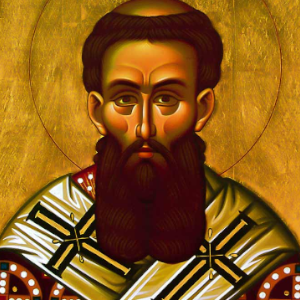
On February 5, the Church celebrates the memory of St. Paulinus the Merciful. The appearance of church bells and bell ringing in Europe is associated with his name. In Russia, where bells came along with Christianity, the art of bell ringing acquired its own specific characteristics over time.
Saint Paulinus the Gracious lived in the 5th century. He received a good education, at the age of 20 he became a senator, and a little later the proconsul of the Campania region in Italy. Subsequently, for the sake of serving God and his neighbors, the saint decided to abandon his public career: he accepted holy orders, and then was elevated to the rank of bishop and became the bishop of the city of Nola. Saint Paulinus was called merciful because of his generosity: he always helped the poor and orphans. Once he even had to give himself up as a prisoner to the barbarians in exchange for the son of a widow.
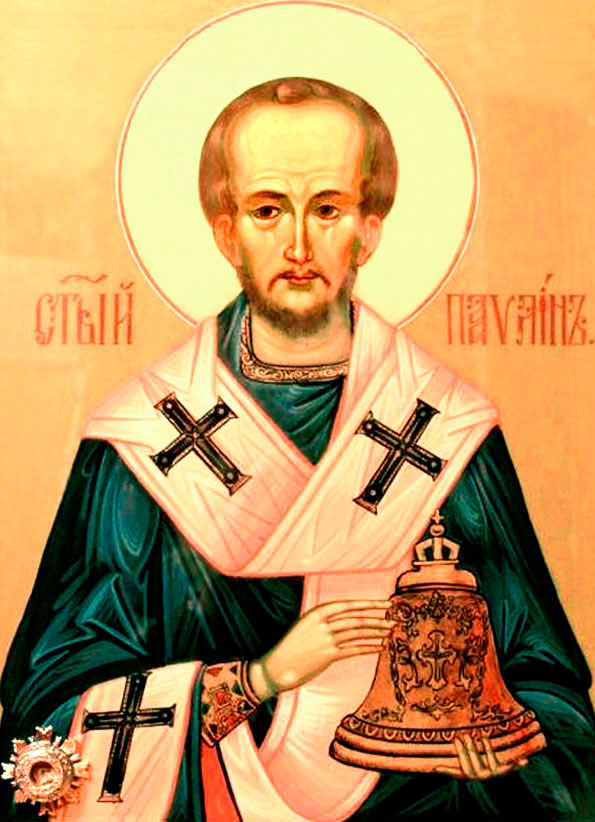
But the saint is known not only for his kindness. Tradition considers him the inventor, and the city of Nolu as the birthplace of church bell ringing. According to legend, one day Paulinus saw in a dream a field in which bluebells grew. When the bishop picked the bell, it rang, after which a voice was heard: “And you do likewise.” The next morning, Paulinus ordered to cast a bell in the shape of a flower. This was the beginning of the tradition of bell ringing in Europe.
Bell ringing in Rus’
With the adoption of Christianity by Russia, bells also appeared in Russian churches: the first mention of bell ringing dates back to 1066, and the first bell cast by Russian craftsmen dates back to 1259.
In the modern Russian Church there is a tradition of bell ringing by striking the body with the tongue of the bell, which differs from the ringing in other Orthodox Local Churches and in the West, where it is not the tongue that is moved, but the bell itself. However, this manner became widespread in Russia only in the 17th century. Previously, bells in Russian churches also swung. Such bells were called “ochepnye” from “ochep” – a pole with a rope at the end, with the help of which the bell was set in motion.
How the bells ring
Bell ringing is performed in churches according to a special charter, which regulates the number of strikes on the bell and the duration of the ringing.
There are three main types of bell ringing:
- Blagovest – measured strikes on the largest bell on holidays and Sundays and on other large bells, but of a smaller size if the service is performed on weekdays. The more significant the holiday, the larger the bell and the number of strikes. There are fewer bells ringing during Lent. There is even the concept of “bell fast”, this is the period from Maundy Thursday to Easter, when, according to the rules, bells should not sound at all (with the exception of the procession with the Shroud).
- Trezvon is the ringing of several bells or all bells (depending on the holiday), which is performed before the start and after the end of the festive service. According to the rules, trezvon should also be performed during the polyeleos* (FOOTNOTE* Polyeleos is a solemn part of the all-night vigil or festive matins), but in practice this is almost never done.
- The ringing and chiming is a funeral bell ringing. It can be heard during the procession with the Shroud, as well as during the removal of the cross and burial. The search is carried out by striking all the bells from small to large.
What types of bells are there?
Church bells are divided into three groups:
- Blagovestniki: the largest bells, take their name from the word blagovest – the ringing of bells before the start of the service. Usually the number of such bells on a belfry is from 1 to 3.
- Medium, or ringing: bells of medium size, with the help of which ringing is carried out. The number of ringing bells varies from 2 to 6.
- Ringing bells: small bells, usually there are 2-3 of them.