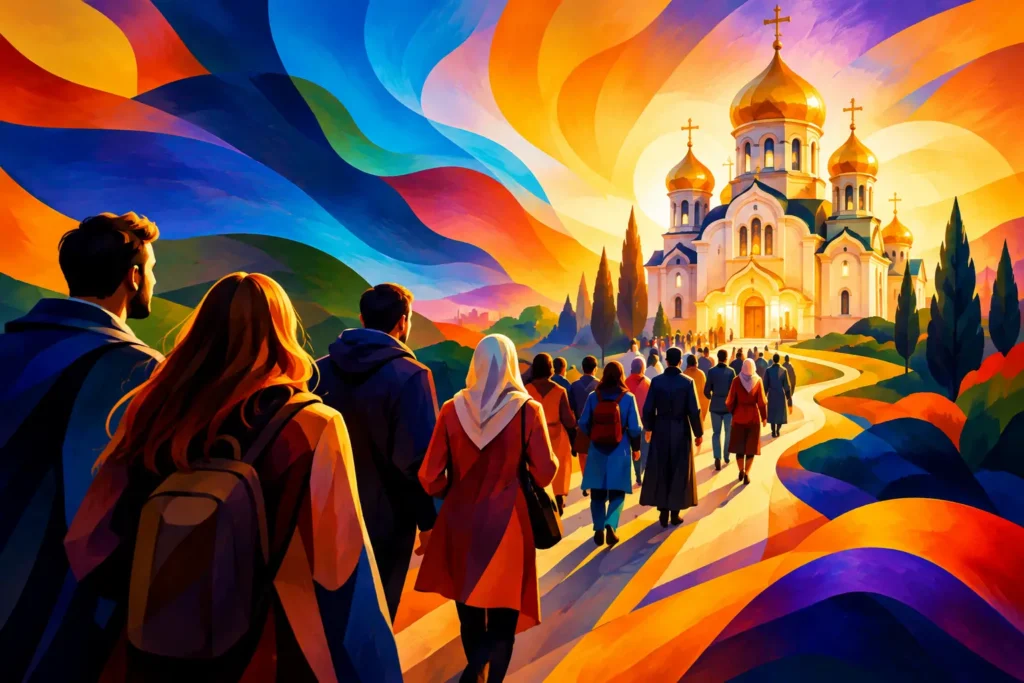
A person may spend years faithfully reading Scripture, serving in a Protestant church, and loving Jesus Christ, yet still sense that something essential is missing. The question is rarely about finding a more interesting Sunday service. For many Protestant converts to the Orthodox Church, it is a search for the Church Christ founded: a visible, sacramental, worshiping community that has kept the apostolic faith through the centuries.
That search deserves patience. Orthodoxy does not ask a seeker to trade one set of religious preferences for another. It calls every person to repentance, communion with Christ, and a new way of life within His Body.
Why Protestant Converts Seek the Orthodox Church
Many Protestant Christians arrive at Orthodoxy because they have taken their own convictions seriously. They have read the Bible carefully and begun asking difficult questions: Who decided which books belong in Scripture? How did the earliest Christians worship? What did Christians believe about baptism, the Eucharist, confession, saints, and the unity of the Church?
The Orthodox answer is not that Christians should set Scripture aside in favor of tradition. Orthodoxy receives Holy Scripture as the inspired word of God and reads it in the life of the Church that recognized, preserved, proclaimed, and obeyed it. Scripture is not detached from the apostolic faith. It is heard in the prayers, hymns, preaching, fasting, feasts, and sacraments of the Church.
This can be startling for someone shaped by a Christian culture in which each congregation, denomination, or individual believer may interpret doctrine independently. Orthodoxy makes a stronger claim: the faith has been given once for all to the saints, and the Church is called to guard it faithfully rather than revise it according to each age.
That claim does not remove every question. It gives questions a home. A convert is not asked to invent Christianity anew, but to receive it with humility and test everything against the worship and teaching of the historic Church.
The Sacramental Life Is Not an Add-On
For many converts, the deepest change is not intellectual. It is sacramental. Orthodox Christianity proclaims that God truly acts in material creation. Water, bread, wine, oil, the laying on of hands, spoken prayer, and the gathered Church are not empty symbols. God uses His creation to communicate grace.
In Holy Baptism, a person is united to Christ’s death and resurrection. In Chrismation, the newly illumined receives the gift of the Holy Spirit. In the Eucharist, the faithful receive the true Body and Blood of Christ. In confession, Christ grants forgiveness and healing through the ministry of His Church.
A Protestant visitor may initially find this unfamiliar, especially if he or she has been taught that sacraments weaken faith in Christ or compete with grace. Orthodoxy teaches the opposite. The sacraments are gifts of Christ. They do not replace faith, personal conversion, prayer, or obedience. They draw the believer into them.
This is also where a person must move beyond abstract comparison. Orthodox worship is not a lecture with religious music added around it. The Divine Liturgy is the Church standing before God, offering thanksgiving, hearing the Scriptures, confessing the faith, and receiving Christ. It asks for attention, reverence, and participation. It may feel foreign at first. Over time, many discover that its depth is not performance but prayer.
Beauty Is a Door, Not the Destination
Icons, incense, chanting, vestments, and ancient prayers often draw visitors through the door. There is nothing wrong with being moved by beauty. The beauty of Orthodox worship bears witness to the glory of God and trains the heart to reverence.
But beauty alone cannot sustain a conversion. A person may admire an Orthodox church while resisting the Orthodox life: regular confession, fasting, submission to Christ’s commandments, generosity, forgiveness, and active membership in a parish. The Church is not an aesthetic refuge from modern life. It is a place where Christ heals and transforms human beings.
Protestant Converts and the Challenge of Authority
The question of authority often stands at the center of a Protestant journey toward Orthodoxy. Protestant traditions vary greatly, and many have admirable seriousness about biblical preaching, mission, and moral life. Yet they also face a persistent question: when Christians disagree on a doctrine essential to salvation and church life, who has the authority to settle the matter?
Orthodoxy does not place final authority in a single modern teacher, a private interpretation, or a vote of the moment. The Church receives the apostolic faith through Scripture, the Ecumenical Councils, the Fathers, the saints, and the continuing liturgical life of the Orthodox Church. Bishops, priests, and laity each have a place, but no one is free to remake the faith.
This can feel both freeing and demanding. It frees the Christian from the exhausting pressure of constructing his own theological system. It demands humility because a convert must learn to say, “The Church is wiser than I am.”
That does not mean Orthodox Christians are never confused, sinful, or poorly taught. They are. Parishes can have weaknesses, clergy can fail, and Orthodox people need repentance as much as anyone else. The truth of the faith does not depend on pretending that its members are perfect. It depends on Christ, who remains faithful to His Church.
Conversion Requires More Than Agreement
A person can agree with Orthodox teachings online and still be unprepared to become Orthodox. Conversion is not completed by reading books, watching lectures, or winning debates. It takes place in the concrete life of a parish under pastoral care.
The Church normally receives inquirers through a period of catechism. This is not a barrier placed in front of sincere people. It is mercy. Catechism gives a seeker time to learn the faith, attend services, ask hard questions, begin spiritual disciplines, and discern whether he is ready to make the promises of baptism or chrismation.
Reception into the Church also requires care because personal histories differ. Some people come from evangelical backgrounds, others from liturgical Protestant communities, and others after years away from any church. The manner in which a person is received is not a private decision or an internet argument. It is handled by the priest and bishop according to the Church’s pastoral practice.
For married couples and families, the path may involve additional questions. What if one spouse is not ready? How should children be prepared? How will Sunday worship, fasting, and family prayer reshape the household? These questions are not reasons to avoid the Church. They are reasons to proceed honestly, patiently, and with pastoral guidance.
What to Do If You Are Considering Orthodoxy
Begin by attending the Divine Liturgy consistently, not just once. Listen to the prayers. Notice what the Church confesses about the Trinity, Christ, salvation, the saints, and the Kingdom of God. Stand with the congregation as you are able, but do not feel pressured to imitate every action before you understand it.
Then speak with a priest. Bring your real questions, including the uncomfortable ones. Ask about salvation, Mary, icons, confession, the Eucharist, Scripture, fasting, and the relationship between faith and works. A serious parish will not dismiss careful questions, nor will it reduce the faith to quick answers.
Read with discipline rather than consuming random online controversy. Learn the Creed. Read one Gospel slowly. Pray each day, even if the prayer is simple: “Lord Jesus Christ, have mercy on me.” Let your investigation become a beginning of repentance rather than merely a theological project.
At All Saints of North America Orthodox Church, inquirers from Surprise, Peoria, Sun City, Glendale, Buckeye, and nearby communities can enter a deliberate path of catechism and post-baptism formation. The goal is not to collect converts. It is to form faithful Orthodox Christians who know the faith, receive the sacraments, and endure in Christ.
If Orthodoxy is drawing you, do not rush to label the feeling or suppress the questions. Come and pray. Give the Church enough of your time to be known from within. Christ does not call us to a religious upgrade. He calls us to follow Him, to die and rise with Him, and to become by grace what He created us to be.