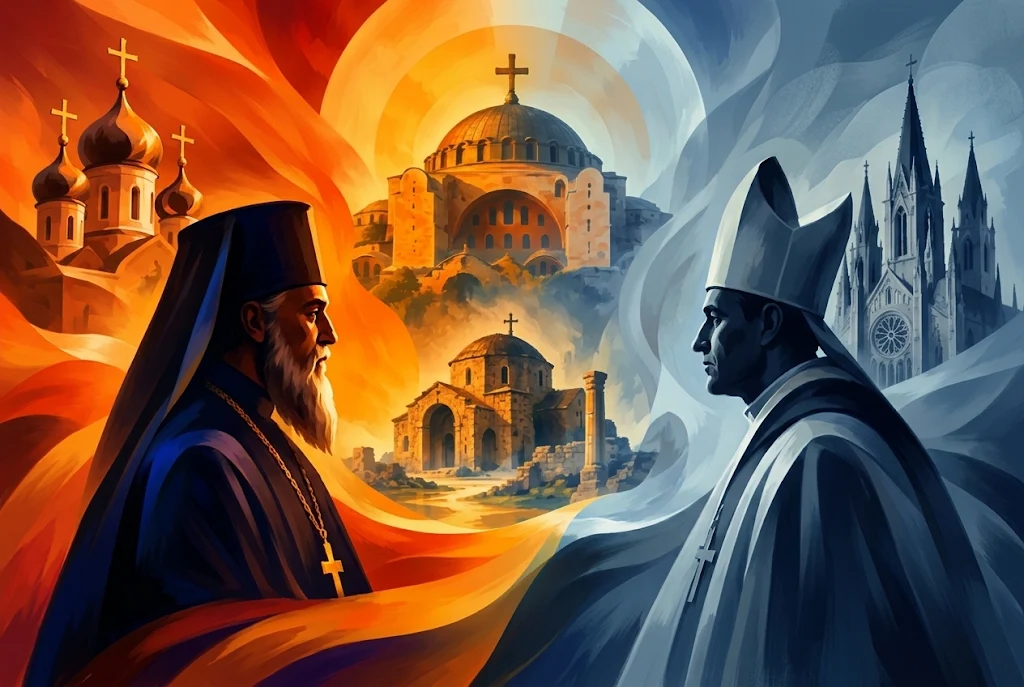
A visitor may walk into an Orthodox church and a Roman Catholic church and recognize much that feels familiar: bishops and priests, sacraments, ancient prayers, incense, fasting, reverence for the saints, and a confession that Jesus Christ is truly God and truly man. Yet Orthodoxy vs Catholicism is not simply a question of two similar styles of Christianity. The differences reach into how each church understands authority, salvation, the Trinity, and the very nature of the Church.
For a Christian seeking the historic faith, this question deserves more than quick internet debates or inherited assumptions. It requires patience, prayer, and a willingness to ask whether the Church today has preserved the faith received from the apostles.
Orthodoxy vs Catholicism: A Shared Beginning
The Orthodox and Roman Catholic churches were united for roughly a thousand years. Both received the Scriptures, the apostolic ministry of bishops, the sacraments, and the doctrinal inheritance of the early Church. Both honor the decisions of the first seven Ecumenical Councils, confess the Holy Trinity, baptize in the name of the Father, Son, and Holy Spirit, and celebrate the Eucharist as the true Body and Blood of Christ.
The separation commonly associated with the year 1054 did not appear out of nowhere on a single morning. Long-standing tensions between the Greek-speaking Christian East and the Latin-speaking West had grown over centuries. Political pressures, cultural distance, disputed practices, and, above all, competing claims about the authority of the bishop of Rome contributed to the break. The sack of Constantinople by Western crusaders in 1204 deepened wounds that had already become grievous.
Orthodox Christians do not believe that the Church ceased to exist after this division or needed to be reconstructed. We confess that the Orthodox Church has preserved the apostolic faith, worship, and life of the undivided Church. Roman Catholicism retains many ancient and holy elements, but Orthodoxy holds that Rome later adopted teachings and claims that the ancient Church did not receive.
The Central Question: Papal Authority
The clearest difference concerns the pope. Orthodox Christians recognize that the bishop of Rome held a place of honor in the ancient Church. Rome was an apostolic church, associated with Saints Peter and Paul, and its bishop was traditionally regarded as first among the patriarchs.
But honor is not the same as universal jurisdiction. In Orthodox Christianity, no bishop has immediate governing authority over every other bishop and every local church. Bishops govern their dioceses, gather in councils, and hold one another accountable to the apostolic faith. The Church acts conciliarity, as seen in Acts 15, where the apostles and elders gathered to discern a matter affecting the whole Church.
Roman Catholic teaching holds that the pope possesses universal, immediate jurisdiction over the entire Church. Vatican I also defined papal infallibility under specific conditions when the pope formally teaches on faith or morals for the whole Church. From the Orthodox perspective, these teachings represent developments that cannot be reconciled with the pattern of the first millennium.
This is not an argument that Orthodox bishops are always wise or sinless. They are not. The question is whether Christ gave one bishop a unique, universal office as the final earthly authority over all Christians. Orthodoxy answers no. The supreme earthly authority in the Church is an Ecumenical Council faithfully expressing the apostolic Tradition, not a single hierarch acting apart from the whole Church.
The Creed and the Filioque
Another major issue is the Filioque, a Latin phrase meaning “and the Son.” The original Nicene-Constantinopolitan Creed says that the Holy Spirit “proceeds from the Father.” In the Western church, the phrase “and the Son” was gradually added, so that the creed came to say that the Spirit proceeds from the Father and the Son.
Orthodox Christians object for two connected reasons. First, no local church has the authority to alter the creed established by an Ecumenical Council without the agreement of the whole Church. Second, the addition affects how we speak about the eternal life of the Holy Trinity. The Father is the one eternal source, or principle, within the Godhead. The Son is eternally begotten of the Father, and the Holy Spirit eternally proceeds from the Father.
Catholics often explain that the Filioque protects the close communion of the Son and the Spirit. Orthodox Christians agree completely that the Spirit is sent into the world through the Son and rests upon the Son. The disagreement concerns eternal procession, not whether the Son and Spirit are united in the work of salvation. This distinction may sound technical, but the Church guards such language because truth about God shapes prayer and worship. The Roman Catholic church uses logical sophistry to its own demise.
Salvation: Healing, Communion, and Theosis
Both Orthodox and Catholics confess that salvation is a gift of God’s grace, made possible by the incarnation, cross, and resurrection of Jesus Christ. Both reject the idea that a person can save himself through moral effort. Still, the theological emphasis differs.
Orthodoxy often speaks of sin as a sickness and death as its terrible consequence. Humanity inherits the mortality and corruption resulting from Adam’s fall, but each person bears guilt for his own sins, not Adam’s personal guilt. Christ enters our death, defeats it through His resurrection, forgives sin, and restores us to communion with God.
The goal of salvation is not merely acquittal from a legal sentence, though forgiveness is real and necessary. It is union with God by grace, often called theosis or deification. As Saint Peter writes, we become “partakers of the divine nature.” We do not become God by nature. We become truly human, healed and transfigured in communion with Him.
Roman Catholic theology also teaches sanctification and communion with God, but it commonly uses different categories in explaining original sin, grace, merit, purgatory, and the Immaculate Conception of the Virgin Mary. Orthodox Christians honor the Theotokos with profound love and confess her complete holiness, yet do not receive the Roman Catholic dogma of the Immaculate Conception as necessary to the faith handed down by the fathers.
The difference is not that one church cares about holiness and the other does not. It concerns the theological framework used to describe humanity’s fall, Christ’s saving work, and the inherited Tradition of the Church.
Sacraments and Worship
Orthodox and Roman Catholics both practice baptism, chrismation or confirmation, Eucharist, confession, marriage, ordination, and anointing of the sick. Both understand these as genuine encounters with Christ, not empty religious symbols. Both preserve liturgical worship rather than treating worship as a platform for religious self-expression.
Yet Orthodox worship has retained a more continuous relationship with the liturgical forms of the Christian East. The Divine Liturgy forms Christians through Scripture, psalms, hymns, fasting, feasts, icons, bodily prayer, and frequent participation in the sacramental life. It is not designed to be short, casual, or consumer-friendly. It trains the whole person to stand before God.
Roman Catholic parishes vary widely in practice, particularly after the reforms of the twentieth century. Some celebrate the Mass with great reverence and doctrinal seriousness. Others have adopted approaches that can feel distant from historic Christian worship. Orthodoxy also has parishes with human weaknesses, because every parish is made of sinners. But the Orthodox liturgical tradition itself remains stable, received rather than reinvented.
Why These Differences Matter
It can be tempting to say that these are merely family disagreements and that doctrine should not divide Christians. Christians should indeed speak with charity. We should never mock Roman Catholics or pretend that their sincere devotion to Christ is meaningless. But love does not ask us to treat truth as unimportant.
Authority determines who may define doctrine. The doctrine of the Trinity shapes our worship. Teaching about salvation shapes how we repent, confess, fast, pray, and face death. The Church is not simply a collection of people who agree that Jesus matters. She is the Body of Christ, called to preserve the faith once delivered to the saints.
For someone raised Roman Catholic, entering Orthodoxy may involve real grief. Family relationships, cherished memories, and familiar practices are not small things. The Church does not ask anyone to treat that journey casually. At the same time, a seeker should be free to examine the claims of Orthodoxy honestly, without assuming that later Western developments are identical to the faith of the apostles.
A Faith to Be Lived, Not Just Compared
The most fruitful way to investigate Orthodoxy is not to remain trapped in comparisons. Attend the Divine Liturgy. Listen before judging what you see. Read the Gospels. Learn to pray. Speak with a priest who can answer questions carefully rather than offering slogans. A serious catechumenate gives time for this work because becoming Orthodox is not joining a religious preference. It is entering a life of repentance, worship, and communion.
At All Saints of North America Orthodox Church, inquirers are welcomed with both warmth and seriousness. Questions about Rome, Roman Catholicism, Protestantism, Scripture, sacraments, and the Christian life deserve patient answers and a clear path forward.
Christ does not call us to win an argument about church history. He calls us to follow Him, to be healed of sin, and to live faithfully within His holy Church. For those who keep seeking with humility and courage, the ancient faith is not a relic of the past. It is a living home.