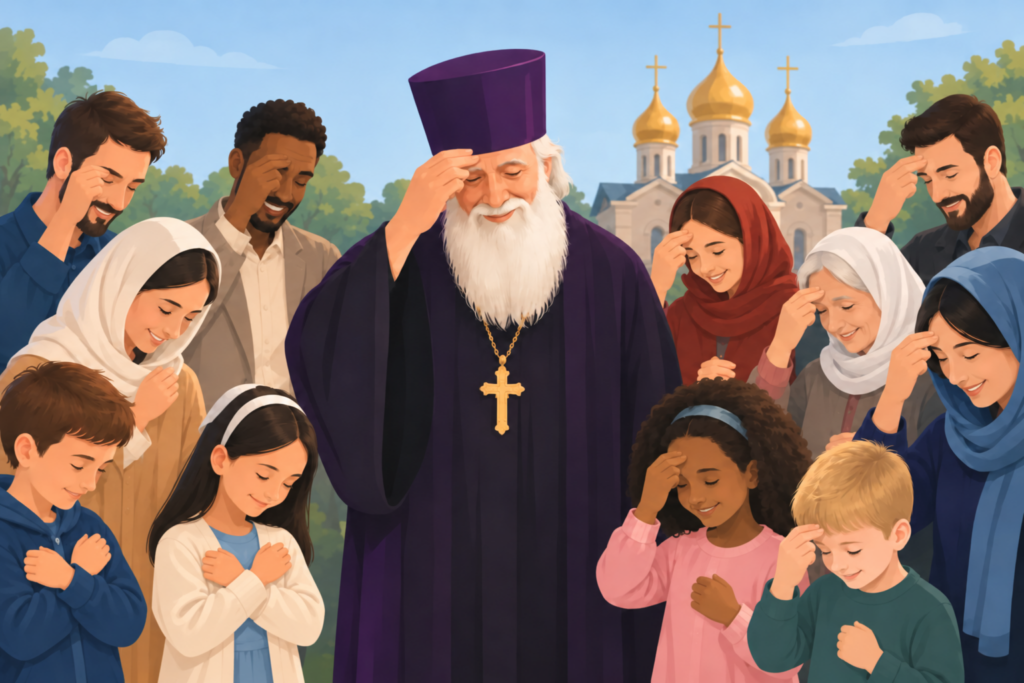
A visitor may notice it before the first hymn begins: Orthodox Christians quietly make the sign of the Cross as they enter the church, approach an icon, hear the Holy Trinity named, or begin to pray. Why Orthodox Christians cross themselves is not a question about religious choreography. It is a question about how Christians confess Christ with the whole person – mind, voice, heart, and body.
The sign of the Cross is a brief but weighty prayer. It declares the central realities of the Christian faith: the Holy Trinity, the incarnation of the Son of God, Christ’s saving death, and His victory over death. It does not replace faith, repentance, or a life of obedience. Rather, it gives those things a bodily expression.
Why Orthodox Christians Cross Themselves in Prayer
Orthodox Christianity does not treat the body as a disposable container for a spiritual life happening somewhere else. God made human beings body and soul. More than that, the eternal Son of God took real human flesh from the Virgin Mary. He ate, wept, suffered, died, rose bodily from the dead, and ascended in that same glorified humanity.
Because Christ has sanctified human nature, Orthodox Christians pray with their bodies. We stand. We bow. We kneel at appropriate times. We fast. We receive Holy Communion. Making the sign of the Cross belongs to this same sacramental vision. It is not an empty gesture added to prayer. It is prayer made visible.
When a Christian crosses himself, he places the Cross of Christ upon his own body. He remembers that he belongs to the Crucified and Risen Lord. The apostle Paul writes, “I have been crucified with Christ,” and also speaks of glorying only in “the cross of our Lord Jesus Christ.” The sign of the Cross brings that apostolic confession close, again and again, into the ordinary moments of prayer.
This is especially significant in a culture that often divides belief from practice. Many people say they believe something but never allow it to shape their habits, their time, their speech, or their bodies. Orthodox worship refuses that division. We do not merely think about the Cross. We stand beneath it.
A confession of the Holy Trinity
The hand itself teaches the faith. Orthodox Christians commonly join the thumb, index finger, and middle finger together. These three fingers confess the Father, the Son, and the Holy Spirit – one God in three Persons. The remaining two fingers are folded into the palm, confessing that Jesus Christ is fully God and fully man.
This is not a private code or a magical formula. It is a simple, ancient way of remembering the Gospel while praying. The Christian who makes the sign of the Cross is confessing the same faith proclaimed in baptism: faith in the Father, the Son, and the Holy Spirit.
The movement also follows a theological logic. The hand goes first to the forehead, then to the chest or abdomen, then to the right shoulder and the left shoulder. Christ came down from heaven for our salvation, took flesh, descended even into death, and has brought humanity from darkness toward the Kingdom. The gesture is small, but Christian doctrine is never small.
How Orthodox Christians Make the Sign of the Cross
In the usual Orthodox practice, the three fingers are joined together and the other two are folded down. The hand touches the forehead, the chest, the right shoulder, and then the left shoulder. The motion should be deliberate, not hurried or careless.
Orthodox Christians make the sign from right to left, unlike the common contemporary Roman Catholic practice of moving from left to right. This difference should not become an occasion for pride or argument. Christians should not use the sign of the Cross to score points against one another. Yet the Orthodox order is meaningful: Christ reigns at the right hand of the Father, and He brings us from death to life, from separation to communion.
Local customs can vary slightly. Some faithful touch the upper chest, while others touch lower. Some communities make a small bow after crossing themselves, especially during services. The essential concern is reverence, not mechanical precision. If you are new, watch carefully, ask questions, and learn without anxiety.
Do not fling the hand through the air or make the gesture so small that it becomes a vague wave. At the same time, do not perform it dramatically for others to see. The sign of the Cross is not theater. It is a personal confession made within the worshiping body of the Church.
When Do Orthodox Christians Cross Themselves?
There is no need to become preoccupied with crossing oneself at every possible moment. Orthodox worship forms believers gradually. Over time, the rhythm becomes familiar and natural.
Faithful Orthodox Christians commonly cross themselves when the Holy Trinity is named, at the beginning and end of personal prayers, when entering or leaving the church, when venerating icons, when receiving a blessing, and during important moments of the Divine Liturgy. They may cross themselves when hearing the Gospel, when the priest blesses the people, or when asking God for help in a moment of fear, temptation, grief, or thanksgiving.
There are also moments in the services when one does not cross, particularly while holding a candle or an object, or when liturgical practice directs the faithful to receive a blessing in another way. A parish priest can help newcomers learn these customs. No sincere inquirer should feel embarrassed for not knowing every movement immediately.
The point is not to create a spiritual checklist. The point is to cultivate remembrance. We forget God easily. We become distracted, resentful, anxious, and self-absorbed. The sign of the Cross interrupts that forgetfulness with a direct confession: Jesus Christ has conquered death, and I belong to Him.
The Cross Is Not a Good-Luck Charm
This needs to be said plainly. Orthodox Christians do not cross themselves to manipulate God, ward off difficulty by technique, or guarantee a desired outcome. The Cross is not superstition baptized with Christian language.
A person can make the sign of the Cross while remaining unrepentant, cruel, dishonest, or indifferent to prayer. The movement by itself saves no one. Christ saves. He calls us to faith, repentance, baptism, prayer, sacramental life, mercy, and perseverance.
Yet rejecting bodily prayer because it can be misused would be a mistake. Words can also be repeated mindlessly, but Christians do not stop praying because some prayers are distracted. Fasting can become prideful, but Christians do not abandon fasting. The answer to misuse is right use, joined to humility.
When made with faith, the sign of the Cross can become a real aid in spiritual struggle. Before a difficult conversation, in the middle of temptation, beside a hospital bed, while driving through a hard season, or when beginning morning prayers, it turns the heart toward Christ. It says, in effect, “Lord, have mercy. Your Cross is my hope.”
An Ancient Practice, Not a Modern Addition
The practice reaches back to the earliest centuries of Christian life. Early Christian teachers encouraged believers to mark themselves with the Cross in ordinary activities and in times of danger. The form has developed over time, as many practices of the Church have, but its conviction has remained steady: the Cross is not an unfortunate detour in the Christian story. It is the place where the love of God is revealed and death is defeated.
For this reason, Orthodox Christians do not hide the Cross from daily life. It appears in churches, homes, devotional objects, and the very movement of prayer. We do not worship wood, paint, metal, or a hand gesture. We worship the Holy Trinity and honor the saving work of Jesus Christ, who freely endured the Cross for the life of the world.
For Protestant and evangelical inquirers, this can initially feel unfamiliar. Many were taught that physical gestures threaten the simplicity of faith. But historic Christianity has always understood that faith takes form. A husband does not reduce love to a feeling; he speaks, serves, gives, remains faithful, and acts. In the same way, Christian faith is not weakened when it is embodied. It is trained.
For those preparing to enter the Orthodox Church, do not try to imitate every external custom before you understand its center. Begin with reverence. Learn the prayers. Attend the services. Ask God to make the Cross not merely a movement of your hand, but the pattern of your life.
The next time you make the sign of the Cross, slow down. Confess the Father, the Son, and the Holy Spirit. Remember the God who took flesh, entered death, and rose again. Then carry that confession into the work, repentance, mercy, and courage set before you.