A question about the Orthodox vs Catholic papacy is never merely a question about church administration. It reaches into the Church’s confession of Christ, the authority of bishops, the meaning of unity, and the way Christians receive the apostolic faith across generations. Roman Catholics and Orthodox Christians share far more than many people realize, but the papacy remains one of the clearest and most consequential divisions between us.
For a seeker, this can feel technical at first. It is not. If Christ founded one Church, then the question of who may speak and act for the whole Church matters deeply. Orthodox Christians do not reject Rome because we oppose order, honor, or visible unity. We reject claims about the pope that we believe exceed the faith and practice of the ancient Church.
What Orthodox and Catholics Share
Orthodox Christians and Roman Catholics confess the Holy Trinity, the divinity and humanity of Jesus Christ, His saving death and bodily resurrection, the authority of Holy Scripture, and the necessity of baptism, repentance, prayer, and holy living. Both hold that bishops stand in apostolic succession. Both celebrate the Eucharist as the true Body and Blood of Christ and honor the saints, the Virgin Mary, and the sacramental life of the Church.
This shared inheritance is why the division is painful. It is not a disagreement between Christians who have nothing in common. It is a wound within the historic Christian world.
The Orthodox Church also acknowledges that the bishop of Rome held a real primacy in the early centuries. Rome was an ancient apostolic church associated with Saints Peter and Paul. Its bishop was honored as first among the patriarchs. When disputes arose, Rome’s witness could carry great weight. But honor, precedence, and influence are not the same as universal governing power.
Orthodox vs Catholic Papacy: Primacy or Supremacy?
The central issue is often described in a short phrase: primacy versus supremacy.
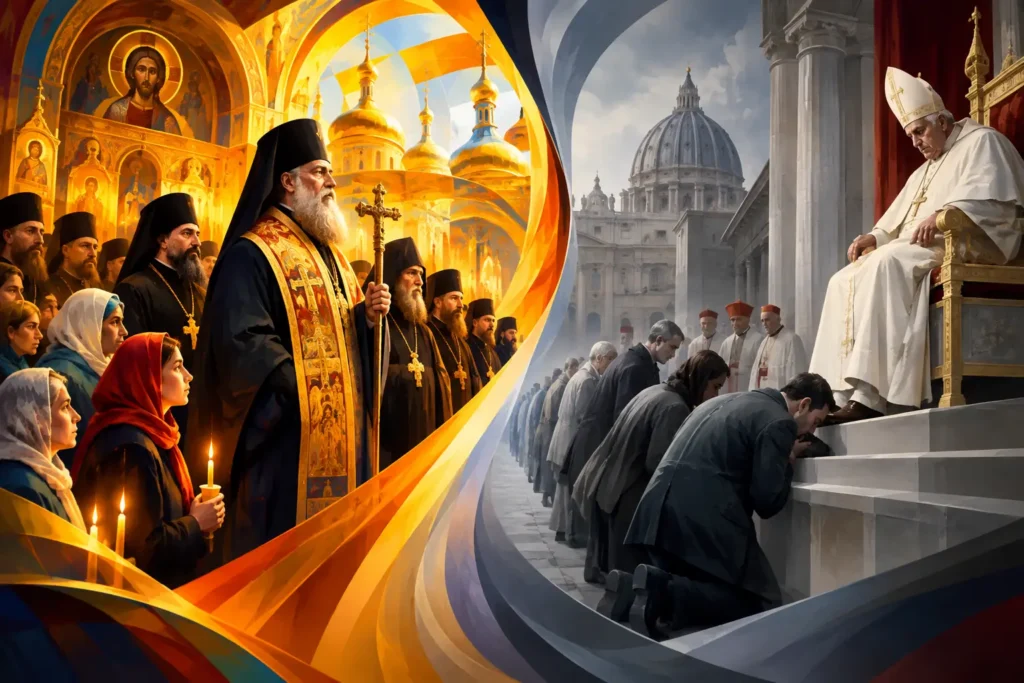
Orthodoxy affirms a primacy of honor. In the order of the ancient patriarchates, Rome held first place. The bishop who is first has responsibilities of service, consultation, and coordination. He may help express unity among the churches. Yet he remains a bishop among bishops, bound by the same apostolic faith and accountable to the Church received through councils, worship, and the consensus of the faithful.
Roman Catholic teaching goes further. It holds that the pope, as successor of Saint Peter, possesses universal and immediate jurisdiction over every Catholic bishop and faithful person. This means the pope may govern the whole Church directly, not merely serve as a respected first bishop or preside in a council.
Orthodox Christians cannot accept this development. The Church is not a collection of local branches governed from one earthly center. It is the one Body of Christ manifested fully in each local Eucharistic church gathered around its canonical bishop. Bishops share one episcopate. No bishop, including the bishop of Rome, stands above the Church as its earthly monarch.
This does not make Orthodoxy individualistic or disorganized. Orthodox churches are bound together by a common faith, sacramental communion, conciliar life, and received tradition. Unity is not created by an office with unilateral power. It is preserved by fidelity to Christ.
The First Millennium Matters
Both Orthodox and Catholic Christians appeal to history, so the real question is not whether Rome had importance. It clearly did. The question is what kind of primacy Rome exercised before the separation between East and West hardened.
In the first millennium, major doctrinal controversies were addressed through councils of bishops. The ecumenical councils did not function as assemblies waiting for a pope to issue an independent ruling. Bishops debated, prayed, examined the apostolic tradition, and confessed the faith together. Rome participated and was honored, but the Church’s supreme authority was conciliar.
Orthodox Christians also point out that popes could be corrected. Pope Honorius I, for example, was condemned after his death by the Sixth Ecumenical Council for language connected to the Monothelite controversy. Whatever one makes of every historical detail, the episode does not fit easily with the later claim that the pope is uniquely protected from error whenever he teaches on faith and morals under defined conditions.
The Orthodox position is not that every bishop is personally incapable of error. Bishops can fail, and history offers sober examples. The Church as a whole, however, cannot permanently abandon the apostolic faith because Christ remains her head and the Holy Spirit guides her into truth.
Papal Infallibility and Universal Jurisdiction
The Roman Catholic Church formally defined papal infallibility at the First Vatican Council in 1870. The teaching is carefully limited. Catholics do not believe every papal statement is infallible. They believe the pope is preserved from error when, speaking ex cathedra, he defines a doctrine of faith or morals to be held by the whole Church.
Still, the Orthodox objection is not solved by saying the definition is rare. The problem is the principle itself. Orthodoxy does not find in Scripture, the ecumenical councils, or the shared practice of the early Church a promise that one bishop may issue irreformable dogmatic definitions apart from a council’s reception.
The same is true of universal jurisdiction. In Orthodoxy, a bishop shepherds a particular flock. He does not normally intervene in another bishop’s diocese without invitation or a canonical process. This is not a minor rule of etiquette. It protects the catholicity of every local church and the equality of bishops in their shared sacramental ministry.
Catholics often see the papacy as a practical safeguard against fragmentation. Orthodox Christians understand that concern. Christians should grieve division, false teaching, and competing voices. Yet centralized power also has a cost. If one office can define doctrine or override bishops throughout the world, the Church’s conciliar character is weakened. A strong structure is not automatically the same as faithful unity.
What About Saint Peter?
Roman Catholic arguments for the papacy often begin with Christ’s words to Peter: “You are Peter, and on this rock I will build My Church,” along with the command to strengthen his brethren and feed Christ’s sheep. Orthodox Christians do not minimize these passages. Peter has genuine prominence among the apostles. He speaks first at Pentecost, confesses Christ boldly, and serves as a visible leader.
But Peter’s prominence does not establish a universal papal office as later defined. In the New Testament, Peter is not portrayed as ruling the apostles alone. At the Council of Jerusalem, the apostles and elders deliberate together. Saint James gives the final pastoral formulation. Saint Paul even rebukes Peter publicly at Antioch when Peter’s conduct compromises the truth of the Gospel.
The fathers interpreted the rock in more than one way: as Peter’s confession of faith, as Christ Himself, or as Peter in his confession as representative of the apostolic faith. The Church honors Peter precisely because he confessed the true Christ. His greatness calls every bishop to confess that same faith, not to claim powers the apostles did not exercise.
Why This Matters for Those Seeking the Church
A person exploring Orthodoxy should not treat this as a debate to win against Catholic relatives or friends. Many Catholics love Christ sincerely, pray faithfully, and seek holiness with real devotion. Speak truthfully, but do so with humility and gratitude for every good gift God gives.
At the same time, do not assume that the difference is only cultural – incense in one place, statues in another, Greek or Latin words, East or West. The papacy shapes how a church understands authority, dogma, councils, and communion. It affects how Christians answer a basic question: when controversy comes, how does the Church discern and confess the truth?
The Orthodox answer is deeply demanding. We do not place our confidence in a single bishop, a passing theological fashion, or private interpretation. We receive the faith once delivered to the saints through the Scriptures read in the Church, the fathers, the councils, the saints, the liturgy, and the sacramental life.
For those in the West Valley who are carrying these questions seriously, All Saints of North America Orthodox Church welcomes honest inquiry. Come to worship, listen before you argue, and bring your hardest questions to a patient catechetical process. The Church does not ask you to trade thought for sentiment. She calls you to meet Christ in the fullness of the faith He has entrusted to His people.