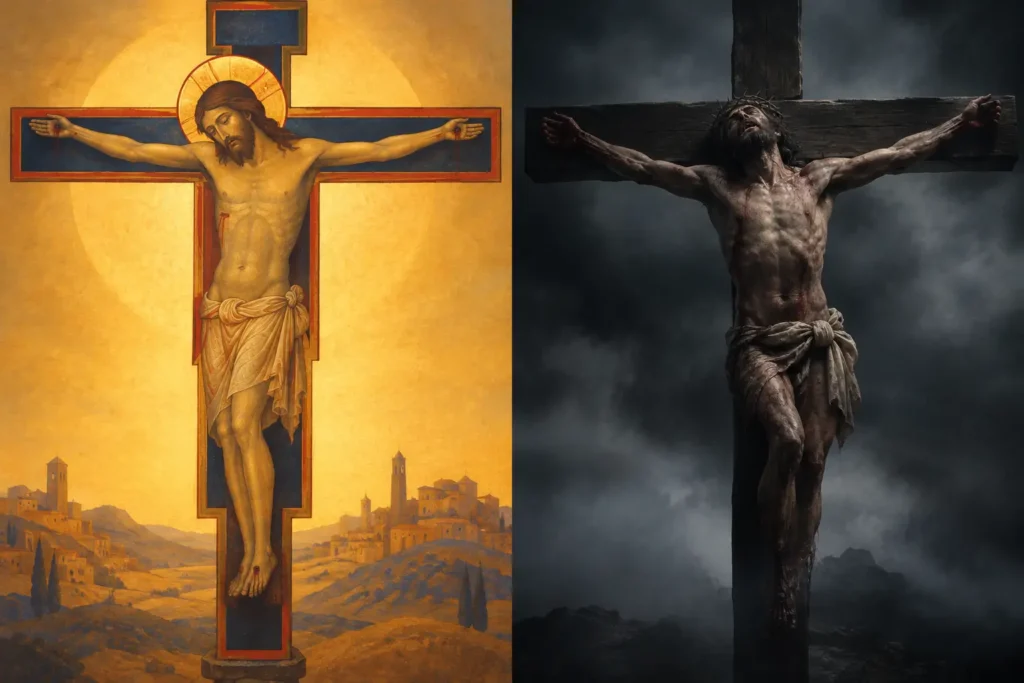
A Christian asks a question that reaches to the heart of everything: What exactly did Christ do on the Cross? The contrast often called Orthodox salvation versus penal substitution is not a quarrel over one isolated theological term. It concerns the character of God, the meaning of sin, the purpose of the Incarnation, and the life into which Christ calls those He saves.
The Orthodox Church does not treat salvation as a legal transaction completed outside the believer, with the Christian left merely to accept its result. Christ truly died for us, offered Himself for us, bore our sins, and reconciled us to the Father. Yet the Church proclaims something larger and more ancient: the Son of God became man to enter the full tragedy of human life, overthrow death, heal our wounded nature, forgive sins, and unite us to God.
What Penal Substitution Teaches
Penal substitution is most closely associated with certain Protestant, especially Reformed and evangelical, accounts of the atonement. In its familiar form, it teaches that humanity deserves God’s judicial punishment for sin. On the Cross, Christ bears that punishment in the sinner’s place, satisfying divine justice so that God may forgive those who trust in Him.
Orthodox Christians should speak carefully here. Not every Protestant explains penal substitution in precisely the same way, and many who use its language also confess Christ’s victory over death, His healing work, and the transforming power of grace. Nor does Orthodoxy deny that Scripture uses courtroom language. God is Judge. Sin brings condemnation. Christ is our sacrifice. He bears our sins. Through Him, we are justified.
The question is whether the legal image is the controlling image, and whether salvation requires us to say that the Father punished the innocent Son with the punishment deserved by guilty people. The Orthodox answer is no.
If this becomes the central account of the Cross, it can make the Holy Trinity appear divided: the Father as the One whose wrath must be satisfied, and the Son as the loving One who steps in to change the Father’s attitude toward us. But the Gospel reveals one divine will and one divine love. The Father sends the Son. The Son freely offers Himself. The Holy Spirit accomplishes and applies the saving work of Christ. God is not reconciled to humanity because the Father needed to be persuaded to love. God acts because He already loves the world.
Orthodox Salvation Versus Penal Substitution: The Central Difference
Orthodox salvation begins with the human condition as Scripture and the Fathers describe it. Sin is guilt, certainly, but it is not guilt alone. Sin is also corruption, alienation, bondage, darkened vision, disordered desire, and death. We do not merely need a favorable verdict. We need to be made alive.
Adam’s fall brought humanity into a realm ruled by death. Fear of death feeds the passions, selfishness, violence, and rebellion that mark human history. The problem is not that God created a penalty He is unwilling to withdraw until someone absorbs it. The problem is that humanity, having turned from the Source of Life, has become captive to death and unable to rescue itself.
Christ enters that captivity without Himself becoming captive to sin. He takes flesh from the Virgin Mary, lives in perfect obedience, accepts suffering freely, dies a real human death, and descends into Hades. There He breaks death from within. His Resurrection is not an encouraging epilogue to a legal settlement. It is the decisive victory. Death could not hold the Author of Life.
This is why the Church sings so boldly at Pascha: Christ is risen from the dead, trampling down death by death, and upon those in the tombs bestowing life. The Cross cannot be separated from the Resurrection, nor can either be separated from the Incarnation. The eternal Son joins Himself to our nature so that our nature may be restored in Him.
Christ Does Not Save Us From the Father
The Cross reveals the self-giving love of the Father, Son, and Holy Spirit. Christ says, “No one takes it from Me, but I lay it down of My own accord.” His offering is voluntary, not a reluctant submission to a Father opposed to mercy.
Scripture can even speak of Christ being made a curse for us and becoming sin for us. The Church receives these words with reverence. Christ takes upon Himself the consequences of our fallen condition: suffering, shame, abandonment, and death. Yet He does not become morally sinful, and the Father does not cease to love Him. The Cross is the perfect obedience and love of the Son, offered to the Father on behalf of all humanity.
The Father is not the enemy from whom Jesus saves us. Sin, death, and the devil are our enemies. Christ comes to destroy their tyranny and bring us home to the Father.
Sacrifice Is More Than Punishment
Orthodoxy does not avoid sacrificial language. The Divine Liturgy calls Christ the Lamb of God, the offering and the offered, the receiver and the received. His sacrifice truly deals with sin. Forgiveness is real, costly, and given through His precious blood.
But biblical sacrifice is not best understood as punishing a victim so that anger can be discharged. Sacrifice is an offering of communion, thanksgiving, purification, and restoration. Christ offers His sinless human life to the Father in perfect love. What Adam refused, Christ gives. Where humanity disobeyed, Christ obeys. Where death reigned, Christ makes death the doorway to life.
The Cross therefore has a judicial meaning, but not a merely judicial meaning. God judges sin by exposing its horror and destroying its power. He forgives sinners not by pretending evil does not matter, but by entering the deepest wound evil has made and healing it at its root.
Salvation Is Union With God
The Orthodox word for the goal of salvation is theosis, often translated as deification. This does not mean that creatures become God by nature. It means that, by grace, we participate in the divine life. Saint Peter speaks of becoming “partakers of the divine nature.” The Son becomes what we are, without ceasing to be God, so that we may become by grace what He is by nature.
This changes how we hear the Gospel. Salvation is not only relief from a future penalty. It is communion with God now. In Baptism, we are united to Christ’s death and Resurrection. In Chrismation, we receive the seal of the Holy Spirit. In the Eucharist, we receive the true Body and Blood of Christ for life, forgiveness, healing, and immortality. In Confession, Christ restores the person who has wounded that communion through sin.
None of this means that works earn salvation. We cannot purchase union with God. Grace comes first, sustains every good response, and heals what we cannot heal. Yet grace does not leave us passive. A person saved by Christ learns repentance, prayer, fasting, mercy, chastity, forgiveness, and perseverance. We cooperate with grace because salvation is a real transformation, not a legal fiction.
Why This Matters for Daily Repentance
A distorted picture of salvation can produce a distorted Christian life. If the Cross is understood only as a punishment transferred from us to Christ, repentance may shrink into relief that someone else has paid a debt. But if Christ has entered death to make us alive, repentance becomes a return to life itself.
We confess not because God needs new information, but because sin poisons the soul and Christ is the Physician. We fast not to impress God, but to train disordered desires. We forgive because we have been forgiven and because resentment binds us to death. We worship because salvation is communion, and communion requires the whole person.
This is demanding, but it is also hopeful. The Church does not tell the angry, addicted, fearful, or spiritually exhausted person, “Try harder until you deserve peace.” She announces that Christ has conquered death and gives His life to those who come to Him in faith and repentance.
A Word for Those Coming From Evangelical Backgrounds
Many seekers arrive in Orthodoxy carrying beloved Bible verses and sincere gratitude for Christ’s sacrifice. They do not need to discard that gratitude. They need to see the fullness of what Christ has done.
The Orthodox Church confesses substitution in a broad and biblical sense: Christ acts for us and on our behalf, doing what we could not do for ourselves. He dies the death we could not escape. He offers the obedience we failed to offer. He bears our sins and opens Paradise to the thief. What Orthodoxy does not confess is that the Father needed to punish the Son as though the Trinity’s love had been set aside to satisfy an abstract legal requirement.
For those in Surprise, Peoria, Glendale, Sun City, and the wider West Valley who are weighing these questions, do not settle for slogans from either side. Bring the question to Scripture, the prayers of the Church, the saints, and a life of worship. Christ did not come merely to adjust your standing before God. He came to raise you from death, cleanse your heart, and make you a participant in His own life. Welcome home.