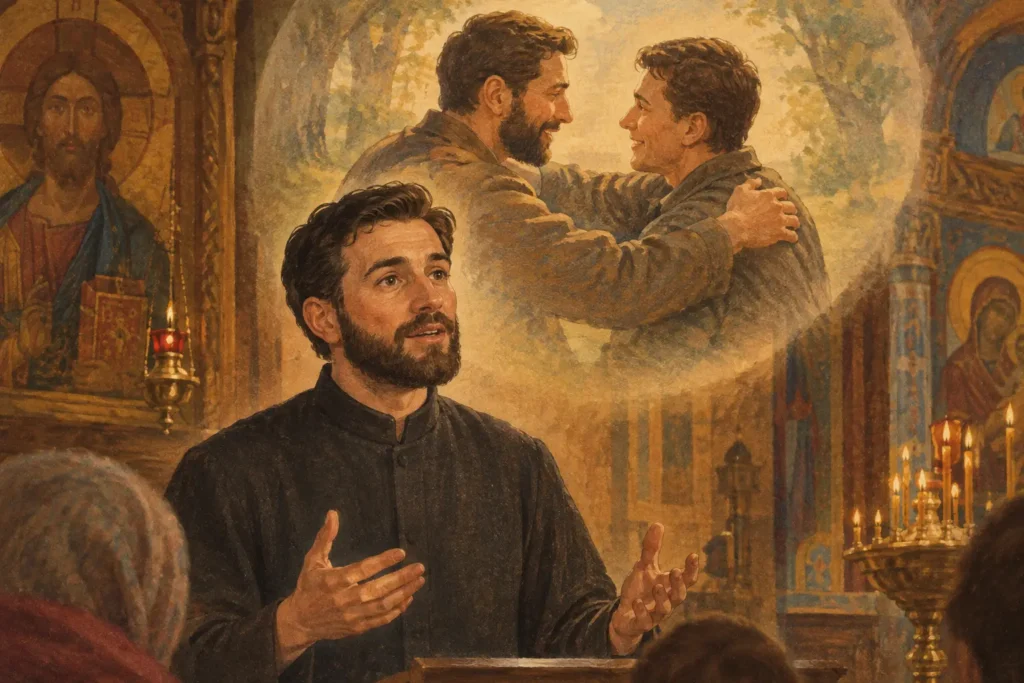
A real Christian testimony of forgiveness does not begin with a polished ending. It begins where the wound still has a name: betrayal in a marriage, a parent’s cruelty, a brother’s silence, a friend’s deception, a long-held resentment that has become part of the soul’s furniture. Orthodox forgiveness testimony stories matter because they speak honestly about this battlefield. They also refuse to leave us there.
The Church does not treat forgiveness as a sentimental feeling or a religious way to avoid conflict. We forgive because Christ forgave us while we were still enemies of God. That truth is demanding. It reaches beyond the moment when someone finally says, “I feel better,” and calls us into repentance, prayer, confession, and a new way of seeing the person who harmed us.
What Orthodox Forgiveness Testimony Stories Reveal
The strongest accounts of forgiveness have a common feature: they do not make sin smaller. They name it. A false peace says, “It was not that bad.” Christian mercy says, “It was evil, it wounded me, and I will not let that evil become the master of my heart.”
This distinction matters for anyone who has been taught that forgiveness means pretending nothing happened. It does not. God never asks a victim to call injustice good. He asks us to bring the injustice to Him, to renounce vengeance, and to refuse the corrosive pleasure of nursing another person’s debt forever.
Forgiveness is therefore not first a transaction between two people. It is an act of obedience before God. The person who hurt you may remain unrepentant, unreachable, or unsafe. Yet Christ can still free you from hatred. You may forgive without restoring access, rebuilding trust, or placing yourself back in danger.
That is not a loophole. It is wisdom. Reconciliation requires two people and the fruits of repentance. Forgiveness begins with the one who has been wounded placing judgment in the hands of God.
Joseph and the long road from injury to mercy
The story of Joseph in Genesis is a pattern that many believers recognize in their own lives. His brothers did not merely offend him. They sold him, lied to their father, and left him for dead. When years later they stood before him in Egypt, Joseph possessed the power to punish them.
Instead, he wept. He tested whether they had changed, and he did not ignore the truth of what they had done. But he refused revenge: “You meant evil against me; but God meant it for good.” Joseph’s mercy was not naive. He saw both the evil intent of his brothers and the providence of God at work through his suffering.
That is often what mature testimony sounds like. A Christian may say, “What happened was wrong. It changed my life. But it did not have the final word.” This is not a claim that every tragedy has an easy explanation. It is confidence that the crucified and risen Christ can bring life where sin intended destruction.
The testimony hidden in confession
Many of the deepest forgiveness stories will never be told publicly. They are spoken quietly in confession, sometimes over many years. A man admits that he has replayed an old insult for decades. A woman recognizes that anger toward her father has begun to shape the way she treats her own children. A spouse confesses contempt after months of cold distance.
The grace of confession is not merely that we receive an absolution formula. We stand in the light. We stop defending the bitterness that has felt justified. We ask Christ to heal what we cannot heal by force of will.
This can be difficult for seekers from backgrounds where confession is unfamiliar. Yet forgiveness is rarely accomplished by repeating a private slogan. The Church gives us concrete medicine: prayer, fasting, confession, the Eucharist, counsel, and patient life within a community that knows repentance is real work.
Forgiveness Is Not the Same as Trust
Some testimony stories become confusing because they collapse several different commands into one. Forgiving an abusive relative does not require inviting him into your home. Forgiving a dishonest business partner does not mean giving him control of your finances again. Forgiving an unfaithful spouse does not automatically answer every question about whether a marriage can be rebuilt.
Trust is earned through truth, repentance, time, and faithful action. In some cases, it cannot be restored. Healthy boundaries may be necessary, especially where violence, manipulation, addiction, or repeated betrayal is present. Speak with a priest, and when needed, seek competent professional help and lawful protection.
The Church never blesses concealment of serious harm for the sake of appearances. Mercy and truth belong together. Christ forgave sinners, but He also called them to repent and commanded truth from those who wanted to follow Him.
This is why a credible forgiveness testimony does not rush the ending. It honors the slow work of healing. A person may choose daily to forgive while still grieving, receiving counsel, and learning how to live safely. That repeated choice is not failure. It is often the very shape of faithfulness.
How the Saints Teach Us to Forgive Enemies
The saints do not offer a shallow command to “be nice.” They show us a radically different allegiance. St. Silouan the Athonite taught that the soul who has known the Holy Spirit loves even enemies and prays for them. Such love is not natural human optimism. It is the fruit of communion with the God who “makes His sun rise on the evil and on the good.”
Praying for an enemy may feel impossible at first. Begin truthfully. Do not force dramatic language that your heart cannot yet bear. You may pray, “Lord Jesus Christ, have mercy on me. Have mercy on the person who harmed me. Deliver us both from evil.” The prayer may initially be dry or even painful. Offer it anyway.
Over time, this prayer changes the place of the wound within us. It does not erase memory. Rather, it places memory before Christ, where resentment no longer has the right to define our identity.
The martyrs give the Church an even more searching witness. They did not deny the violence done to them. They endured it while praying for those who persecuted them. Their witness reveals that forgiveness is not weakness before evil. It is spiritual freedom that evil cannot conquer.
A Practical Rule for the Person Who Cannot Let Go
If someone’s sin keeps returning to your mind, do not conclude that you have failed because the memory remains. Instead, make the return of that memory a call to prayer. Say the Jesus Prayer. Ask God to bless the person if you can. If you cannot yet say that honestly, ask God to make you willing to pray for him or her.
Then examine your own heart without self-deception. Are you rehearsing the injury because you want justice, or because you have begun to enjoy feeling morally superior? Do you need to speak the truth directly? Do you need distance? Do you need to confess your rage, envy, or desire for revenge?
This is where a priest’s guidance is a gift. Forgiveness is personal, but it should not be isolated. The Church helps us distinguish righteous grief from a passion that is consuming us. She also reminds us that we stand before God as people who need mercy ourselves.
For those in the western Phoenix area who are carrying such burdens, All Saints of North America Orthodox Church welcomes serious questions and serious seekers. Come to worship, listen, learn the faith, and bring your wounds into a community where Christ is not presented as an idea, but as the Physician of our souls and bodies.
The next time the old hurt rises, do not make a promise to feel nothing. Make a smaller and truer offering: “Lord, I place this person and this wound into Your hands.” Return to that prayer as often as necessary. In Christ, even that trembling act can become the beginning of freedom.