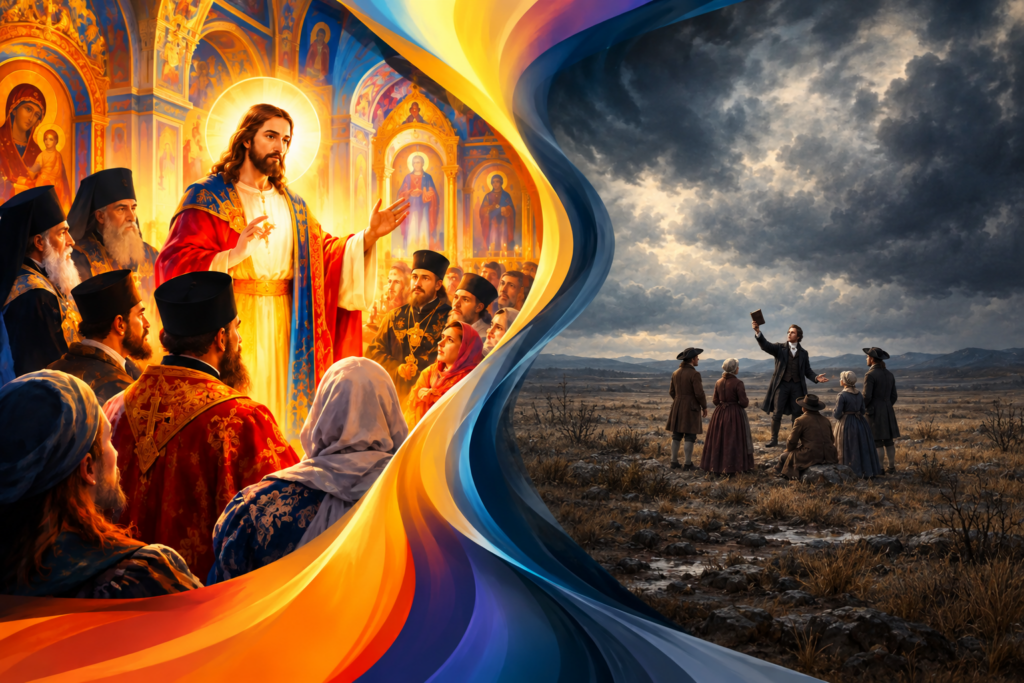
A Mormon Orthodox testimony conversation often begins with a familiar claim: “I know this is true.” Orthodox Christians do not mock the desire for certainty, nor do we deny that God can move the heart with real conviction. But the question before us is more searching: What makes a religious claim true? Is an inward experience sufficient, or must every experience be tested by the Christ proclaimed by the apostles and worshiped by His Church?
For many members of the Mormon Church, testimony is central. It is cultivated through prayer, obedience, fasting, scripture study, and a personal request for divine confirmation. For Orthodox Christians, faith is also personal, costly, and experiential. Yet it is never private. The Orthodox Christian receives faith as the life of the Church – the Church that confesses the Holy Trinity, baptizes into Christ’s death and resurrection, celebrates the Eucharist, and guards the apostolic faith through the centuries.
Why Mormon Orthodox Testimony Raises a Deeper Question
The difference is not merely that one person has a testimony and another does not. Orthodox Christians have testimony in the older and stronger sense of the word: witness. The Greek word martyria gives us the word martyr. A Christian witness is not simply reporting a warm inward assurance. He is bearing witness to the risen Lord with his whole life, even when that witness costs him comfort, reputation, or life itself.
The apostles did not preach, “We prayed about a new book and felt peace.” They preached what they had seen and heard: Jesus Christ crucified and risen from the dead. They bore witness to the One whom they touched, followed, and encountered after His resurrection. Their preaching was public, concrete, and accountable. It was received by communities of believers, preserved in worship, and defended against teachings that changed the identity of God or the Gospel.
That historical and ecclesial character matters. A strong feeling can accompany truth, but it can also accompany error, wishful thinking, fear, group loyalty, or spiritual deception. Scripture itself warns Christians to test the spirits. The heart is not a machine that produces infallible religious conclusions simply because we ask a sincere question.
This is not an insult to sincere Mormons. Sincerity deserves respect. Many Mormons pray seriously, seek moral discipline, love family life, and genuinely desire to follow God. Yet sincerity cannot settle whether Joseph Smith was a prophet, whether the Book of Mormon is historically and theologically reliable, or whether the Mormon understanding of God agrees with the faith delivered once for all to the saints.
The God Christians Confess
The central issue is God Himself. Orthodox Christianity confesses one God: the Father, the Son, and the Holy Spirit. God is not three separate gods who cooperate in purpose. He is one divine Being in three distinct Persons. The Father is eternally Father, the Son is eternally begotten of the Father, and the Holy Spirit eternally proceeds from the Father. This is not abstract speculation. It is the name into which Christians are baptized and the God whom the Church worships.
The Mormon understanding of the Godhead differs at this point in a fundamental way. Latter-day Saint teaching speaks of the Father, Son, and Holy Ghost as distinct beings united in purpose. It also includes teachings about God’s exaltation and human beings’ potential exaltation that stand outside the apostolic and Nicene Christian faith.
Orthodoxy cannot treat this difference as a minor disagreement among Christians. If God is other than He has revealed Himself to be, then worship, salvation, prayer, and the meaning of Christ’s incarnation are all affected. The Church does not confess the Trinity because theologians wanted difficult language. She confesses the Trinity because the Father sent the eternal Son for our salvation and poured out the Holy Spirit upon His people.
Christ is not one being among many on a path of advancement. He is the eternal Word of God, fully divine and fully human. He did not come merely to provide a plan. He came to conquer death, forgive sins, unite humanity to God, and make us partakers of divine life by grace. Orthodox Christians speak of becoming like God, but never of becoming gods by nature. The Creator remains Creator. The creature is healed, sanctified, and glorified through communion with Him.
A Restored Church or the Church That Endured?
LDS claims also depend upon a “Great Apostasy” – the belief that the original Church fell away so completely that priesthood authority and true doctrine had to be restored through Joseph Smith. This claim should be examined plainly. If the whole Church vanished from the earth, what becomes of Christ’s promise that the gates of Hades would not prevail against it? What becomes of His promise to remain with His disciples always?
The Orthodox Church does not claim that every bishop, emperor, priest, or layman has always behaved faithfully. Church history includes sin, cowardice, betrayal, and conflict. But human failure is not the same as the disappearance of the Church. Christ preserves His Body even while calling its members to repentance.
The continuity of Orthodoxy and the Orthodox faith is visible in the worship, creeds, councils, saints, Scriptures, sacraments, and spiritual life of the early Church. The same Church that confessed Christ against heresy, baptized in the name of the Trinity, and celebrated the Eucharist in the ancient centuries continues to do so now. The Church has needed repentance and renewal many times. She has not needed replacement.
How Orthodoxy Tests Spiritual Experience
Orthodox Christians do not dismiss experience. We pray because God hears. We fast because the body participates in repentance. We confess because Christ forgives through His Church. We ask saints to pray for us because death does not separate the living members of Christ’s Body. We expect grace to transform us.
But Orthodoxy teaches sobriety about religious feelings. Not every bright thought is from God. Not every peaceful sensation is divine confirmation. The saints consistently warn against spiritual self-deception, especially when someone assumes that a powerful experience proves his interpretation beyond correction.
An experience is tested in the Church. Does it lead to humility rather than self-importance? Does it agree with the Scriptures as the Church has received them? Does it confess the true Christ? Does it bear the fruit of repentance, patience, chastity, mercy, and love? Can it be brought before a mature spiritual father without defensiveness?
This may feel less immediate than a private method for receiving certainty. It is also safer. The Christian life is not built on winning an argument with oneself. It is built on learning to recognize the voice of the Good Shepherd within the communion of His flock.
A Better Question Than “Did I Feel It?”
If you come from Mormon background, you may carry experiences that are deeply personal. Do not pretend they did not matter. Bring them honestly before Christ. But do not let an experience become untouchable. Ask what it testified to. Ask whether it led you to the God revealed by the apostles. Ask whether it can bear the weight of history, Scripture, worship, and the communion of saints.
A helpful question is not merely, “Did I receive a feeling?” Ask, “Who is Jesus Christ, and where is the Church He established?” That question requires patience. It may require reading, prayer, conversations, and the courage to let long-held assumptions be examined. It also requires more than comparing isolated proof texts.
For those in the west Phoenix area who are asking these questions, All Saints of North America Orthodox Church welcomes serious inquirers. Come to Vespers or the Divine Liturgy. Listen before trying to explain everything. Meet the Christ whom the Church worships, not only as an idea but in prayer, Scripture, sacrament, and a people being formed by repentance.
You do not need to manufacture certainty before you begin. Bring your questions, your grief, your convictions, and your desire for truth. Christ is not threatened by honest examination. He calls us not to a passing religious impression, but to communion with the living God.