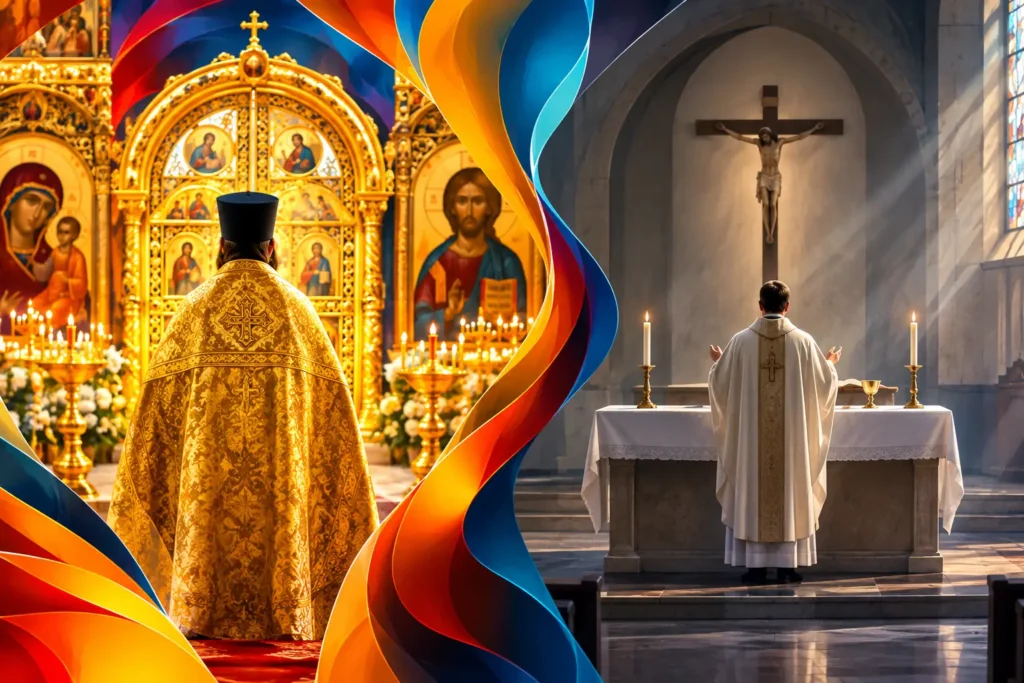
A visitor may enter an Orthodox church, hear the clergy refer to the Divine Liturgy, and wonder why no one calls the service “Mass.” The question of liturgy versus mass is not merely about vocabulary. The words reveal something about how Christians understand worship, the Church, and the Eucharist itself.
For someone coming from Roman Catholicism, Anglicanism, evangelical Christianity, or no church background at all, the simplest answer is this: the Mass is a liturgical service, while “liturgy” is a broader word. In Orthodox usage, however, the Divine Liturgy is the Church’s central Eucharistic worship. It is not a religious performance, a sermon with music, or a gathering designed around personal preference. It is the worship of heaven received and offered on earth.
Liturgy Versus Mass: The Basic Difference
The word liturgy comes from a Greek word meaning a public work or service undertaken for the people. In Christian use, it refers to the Church’s ordered worship. Orthodox Christians may speak of the Divine Liturgy, Vespers, Matins, the services of Holy Week, baptisms, weddings, funerals, and other appointed prayers as liturgical services.
More specifically, the Divine Liturgy is the Eucharistic service in which the faithful receive Holy Communion. The best-known form is the Divine Liturgy of St. John Chrysostom, celebrated on most Sundays and feast days. On certain days, the Church uses the Divine Liturgy of St. Basil the Great, which contains longer prayers and carries the same Eucharistic reality.
The word Mass comes through the Latin tradition, commonly connected with the dismissal at the end of the service: Ite, missa est – “Go, it is the sending forth.” Roman Catholics call their principal Eucharistic service the Mass. In ordinary conversation, then, “Mass” usually means Roman Catholic Eucharistic worship, while “Divine Liturgy” identifies Orthodox Eucharistic worship.
That distinction should not be exaggerated into a false contrast. A Catholic Mass is liturgical worship. The Orthodox Divine Liturgy is also a liturgy. The words are not competing names for unrelated activities. They arise from different Christian traditions and carry different theological histories.
Why Orthodox Christians Say “Divine Liturgy”
Orthodox Christians use the term Divine Liturgy because worship belongs first to God. We do not invent worship each week. We enter into the praise offered eternally by angels and saints before the throne of God.
This is why Orthodox worship is filled with Scripture, psalms, processions, incense, icons, sung prayer, repeated petitions, and reverent bodily participation. The congregation does not watch clergy “do church” on its behalf. The people answer, sing, pray, cross themselves, stand, bow, confess, and receive. The whole Church offers worship together.
The Divine Liturgy also makes clear that the Eucharist is not merely a memorial meal in the modern sense. Christ truly gives us His Body and Blood. The bread and wine become, by the work of the Holy Spirit, the holy gifts of Communion. This mystery cannot be reduced to ordinary categories, yet the Church speaks plainly: we receive Christ Himself for the forgiveness of sins and life everlasting.
Orthodox Christians call this service “divine” not because the congregation escapes ordinary human life for an hour, but because God draws human beings into His life. The Liturgy forms us to repent, forgive, give thanks, serve our neighbor, and carry Christ into the week ahead.
Is the Orthodox Divine Liturgy the Same as the Roman Catholic Mass?
There is real common ground. Both Orthodox Christians and Roman Catholics reject the idea that the Eucharist is only a symbolic reminder. Both preserve ancient patterns of prayer, ordained priesthood, sacramental life, fasting, confession, and reverence before the holy gifts. A Roman Catholic who visits an Orthodox parish will recognize much that is ancient and unmistakably Christian: Scripture readings, intercessions, vestments, an altar, Eucharistic prayer, and Communion.
Yet common elements do not erase the divisions between the Orthodox Church and the Roman Catholic Church. The separation is not simply a matter of language, architecture, or whether one says “Mass” instead of “Liturgy.” It involves substantial questions of doctrine and ecclesial authority, including the role and claims of the pope, the Filioque addition to the Creed in the West, and developments in Roman Catholic dogma that Orthodoxy does not receive.
For that reason, Orthodox and Roman Catholics are not presently in full communion. An Orthodox parish does not practice open Communion. Receiving the Eucharist expresses full unity in the faith, not merely personal sincerity or respect for the service. Visitors are warmly welcomed to pray with us, but only Orthodox Christians who have prepared through confession, fasting, prayer, and the blessing of their priest receive Holy Communion.
This can feel unfamiliar, especially to Christians formed by churches where anyone who loves Jesus may receive. But the Orthodox practice is not meant as a rejection of visitors. It protects the truth that Communion is communion: a visible participation in one faith, one sacramental life, and one Church.
What Happens at an Orthodox Divine Liturgy?
The Divine Liturgy has a recognizable movement. It begins with prayers, litanies, psalms, and hymns that prepare the people to hear the Word of God. The clergy process with the Gospel book, Scripture is read, and the priest or deacon preaches.
Then the Church turns toward the Eucharistic offering. Bread and wine, prepared beforehand, are brought to the altar. The faithful pray for the whole world, for the Church, for civil authorities, for the suffering, and for those who have fallen asleep in the Lord. The priest gives thanks, recalls Christ’s saving work, and invokes the Holy Spirit upon the gifts and upon the people.
After the Lord’s Prayer and further preparation, Orthodox Christians receive Communion from a common chalice. The Liturgy closes with thanksgiving and a dismissal, sending the faithful back into the world to live what they have received.
The service may feel long to someone accustomed to a forty-five-minute gathering. It is also intentionally unhurried. The Church does not measure worship by efficiency. We make room for confession, adoration, Scripture, intercession, silence, beauty, and the mysteries of God.
What Should a First-Time Visitor Do?
Come as you are, but come ready to pray. You do not need to know every response, make every sign of the cross, or understand each hymn on your first visit. Follow the service as you are able. Stand when others stand if you can, sit when needed, and do not worry about getting everything right.
If you are not Orthodox, you may still receive the blessed bread, often called antidoron, that is distributed at the end of the service. It is not Holy Communion, but it is offered as a sign of hospitality. Parents should guide their children, and visitors should feel free to ask a priest or parishioner for help after the service.
Those exploring Orthodoxy should resist the temptation to treat the Liturgy as a curiosity to be evaluated from a distance. Attend faithfully. Listen carefully. Learn the faith that gives the service its meaning. The Divine Liturgy becomes clearer as the Church’s teaching, prayers, fasting, feasts, and sacramental life become part of your own life.
At All Saints of North America Orthodox Church, newcomers from Surprise, Peoria, Glendale, Sun City, Buckeye, and surrounding communities are invited to begin that journey with patience and seriousness. Questions are welcome. So is the willingness to be formed rather than simply entertained.
The difference between liturgy and Mass matters, but the greater question is personal: where will you learn to stand before God, receive His mercy, and be changed by His life? Come and pray with the Church. Welcome home.