A visitor may enter an Orthodox church and see Christ, His Mother, the saints, candles, incense, and people bowing before painted images. The question of icons versus idols then becomes urgent, especially for Christians formed by a strong fear of idolatry. That fear is not wrong. God commanded Israel not to worship false gods. Orthodox Christians take that commandment with complete seriousness. The question is whether every religious image is an idol, or whether God Himself has given us a different way to understand holy images.
Icons Versus Idols: The Essential Difference
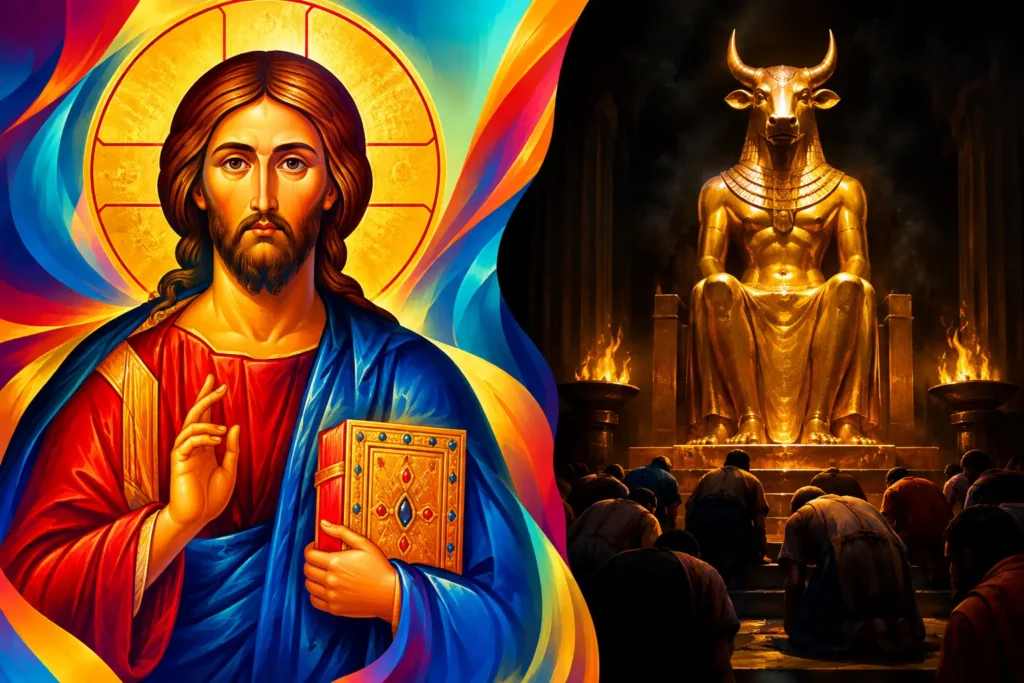
An idol is a false god, or an image treated as though it were a god. It receives the worship owed to the Creator alone. An icon is a sacred image that points beyond itself to the person depicted. Orthodox Christians do not believe that wood, paint, gold leaf, or canvas possesses divine power by nature. We do not pray to pigment.
This distinction may sound subtle until we consider ordinary human life. A family may kiss a photograph of a departed grandmother. No one imagines that the paper is the grandmother. The gesture expresses real love for the person remembered through the image. An icon operates on this same basic principle, though in a holier and more deliberate setting. Honor shown to the image passes to the one portrayed.
When an Orthodox Christian bows before an icon of Christ, he worships Christ, not the board. When she kisses an icon of the Theotokos or a saint, she honors a faithful servant of God and asks for that saint’s prayers. Worship belongs to the Holy Trinity alone: Father, Son, and Holy Spirit. Veneration belongs to those we do not worship, but whom we honor.
The Church has traditionally used distinct language for these acts. Worship, or adoration, is offered only to God. Veneration means honor, reverence, and love. English speakers may use the word worship loosely in everyday conversation, but Orthodox teaching does not blur the line. To confuse veneration with worship is to misunderstand both.
The Commandment Against Idols Does Not Forbid All Images
The second commandment forbids making images for the purpose of bowing down to them as gods. Yet the same God who gave that commandment also commanded the making of sacred images for Israel’s worship.
God instructed Moses to place golden cherubim over the Ark of the Covenant. The Temple contained carved cherubim, palm trees, flowers, and other sacred imagery. These were not idols because Israel was not commanded to worship created things. They were signs of God’s heavenly kingdom and reminders that the Lord reigns among His people.
This matters because the Bible does not present a simple rule of image versus no image. It presents a far more searching question: whom do you worship? Israel fell into idolatry when it turned from the living God to created things, whether a golden calf, the powers of nature, wealth, nations, or its own desires. An empty room can contain an idol just as easily as a room filled with icons.
The human heart is capable of making an idol out of nearly anything – political power, comfort, romance, success, control, ideology, or even religious self-righteousness. The commandment calls us to repent of false worship, not merely to remove religious art from our sight.
The Incarnation Changes What Can Be Depicted
The deepest Orthodox answer rests on the Incarnation. The eternal Son of God truly became man. Jesus Christ was seen, touched, heard, and known in a human body. As St. John writes, the apostles beheld Him with their eyes and touched Him with their hands.
Before the Incarnation, God had not revealed His divine nature in a visible human form. God is invisible, uncircumscribed, and beyond every creaturely image. But in Jesus Christ, the invisible God took flesh without ceasing to be God. The Son did not merely appear to be human. He became man for our salvation.
For this reason, an icon of Christ does not attempt to portray the divine essence. No painting could do that. It portrays Jesus Christ as He freely revealed Himself in the flesh: the one Person who is fully God and fully man.
To reject every image of Christ can unintentionally imply that His humanity was unreal, unimportant, or unworthy of depiction. The Church confessed the opposite. Because the Word became flesh, matter can serve the proclamation of the Gospel. Wood can become a cross. Water can be joined to baptism. Bread and wine become the Eucharistic gifts. Paint can confess that Christ came in the flesh.
This is why the defense of icons became so important in the early Church. The Seventh Ecumenical Council affirmed their proper veneration, not as a decorative preference, but as a confession of the Incarnation. Icons proclaim that salvation is not an escape from God’s material creation. In Christ, creation is being healed and offered back to God.
What an Icon Is Meant to Do
An icon is not religious wallpaper. It teaches, confronts, and invites prayer. Its beauty is purposeful. The saints are not painted as celebrities from another age. They appear as men and women transfigured by the grace of God, with faces turned toward the Kingdom.
Icons also teach the Church’s faith without reducing it to private opinion. An icon of Christ’s Baptism proclaims the revelation of the Holy Trinity. An icon of the Resurrection proclaims Christ’s victory over death. An icon of a martyr reminds us that faithfulness costs something and that death does not have the last word.
For someone new to Orthodoxy, the presence of icons can feel unfamiliar at first. That is understandable. Do not pretend to feel what you do not yet understand. Stand quietly. Look carefully. Notice that the icon is not asking you to admire technique or invent your own spiritual meaning. It calls you to meet the Christ whom the Church confesses and to remember that His saints are alive in Him.
Common Concerns From Serious Christians
Some Christians ask, “Why not pray directly to God?” Orthodox Christians do pray directly to God, constantly. We also ask other Christians to pray for us. Asking the saints for their prayers follows the same conviction: those who have died in Christ are alive to Him. The Church is one body, not a fellowship broken apart by death.
Others worry that practices such as kissing an icon are too physical. Yet Christian faith has always been physical because God made us bodily creatures and redeemed us bodily creatures. We are not disembodied intelligences. We kneel, stand, fast, sing, make the sign of the cross, receive water, bread, and wine. These actions do not replace inward faith. They train the whole person to offer himself to God.
There is also a needed warning for Orthodox Christians themselves. An icon can be mishandled if someone treats it superstitiously, as a charm for luck or a tool for controlling God. The Church does not bless superstition. A holy image calls us to repentance, faith, prayer, and obedience. It cannot substitute for a life of confession, forgiveness, sacramental communion, and love of neighbor.
Learning to See With the Church
The difference between icons and idols becomes clearer when we stop asking only, “What does this object look like?” and begin asking, “What does this act confess?” An idol turns the heart inward or toward a creature. An icon directs the heart toward the living God and His saving work in Christ.
If you are exploring Orthodoxy, do not let a first impression settle a question that deserves patient study. Read the Scriptures with the Church’s worship in view. Attend Vespers or the Divine Liturgy. Listen to the prayers offered before the icons. You will find no invitation to replace God with saints, angels, or religious objects. You will find the Church giving glory to the Father, through the Son, in the Holy Spirit.
At All Saints of North America Orthodox Church, seekers are welcome to ask direct questions and to learn without pressure or pretense. The path into Orthodox faith is not built on collecting unfamiliar customs. It is built on coming to know Jesus Christ, receiving His life in the Church, and allowing that life to reshape the heart.
Stand before an icon of Christ long enough to pray one honest sentence: “Lord Jesus Christ, have mercy on me.” The painted icon will not save you. But the Savior it proclaims meets all who turn to Him in faith.