Why Orthodox Christianity Requires Icons
Orthodox Christianity does not regard icons as optional religious decoration. Their necessity arises from the Church’s confession of Jesus Christ: the eternal Word of God truly became flesh, entered history, possessed a visible human face, and remains forever the God-man. The defense of icons is therefore not fundamentally an argument about art. It is an argument about the Incarnation, the nature of Christian worship, the sanctification of matter, and the difference between objective revelation and the private constructions of the imagination.
The Seventh Ecumenical Council at Nicaea in AD 787 defended the making and veneration of holy icons while distinguishing such veneration from the worship due to God alone. This distinction matters, but it does not exhaust the Orthodox case. Icons are necessary because they bear visible witness to what Christianity claims has actually happened: the invisible God has become visible in the flesh.
The Incarnation Changes the Icon Question
The Old Testament prohibition against images of God protected Israel from misrepresenting the invisible and uncircumscribable Creator. No created form could truthfully portray the divine nature. But Christianity announces a decisive event: “The Word became flesh and dwelt among us” (John 1:14). The Son of God did not merely appear human. He assumed a real human nature, body, face, history, and place in the world.
This is the central insight emphasized in Fr. John A. Peck’s essay, “The Necessity of Iconography and the Idolatry of Gnosticism.” Before the Incarnation, an attempted portrait of God would necessarily have falsified Him. After the Incarnation, refusing in principle to depict Christ can communicate the opposite falsehood: that God has not truly entered visible, embodied human existence.
The icon of Christ does not depict the divine essence. It depicts the divine Person of the Son according to the humanity He truly assumed. St. John of Damascus made this point forcefully during the iconoclastic controversy: when the invisible One becomes visible in the flesh, His visible form may be portrayed.
Thus iconography protects Christology. To confess that Jesus is fully God and fully man while insisting that His humanity is inherently undepictable introduces a contradiction. A real human body can be seen; a real human face can be represented. The icon insists that the Incarnation was objective, historical, bodily, and permanent.
Iconoclasm and the Danger of a Disembodied Christianity
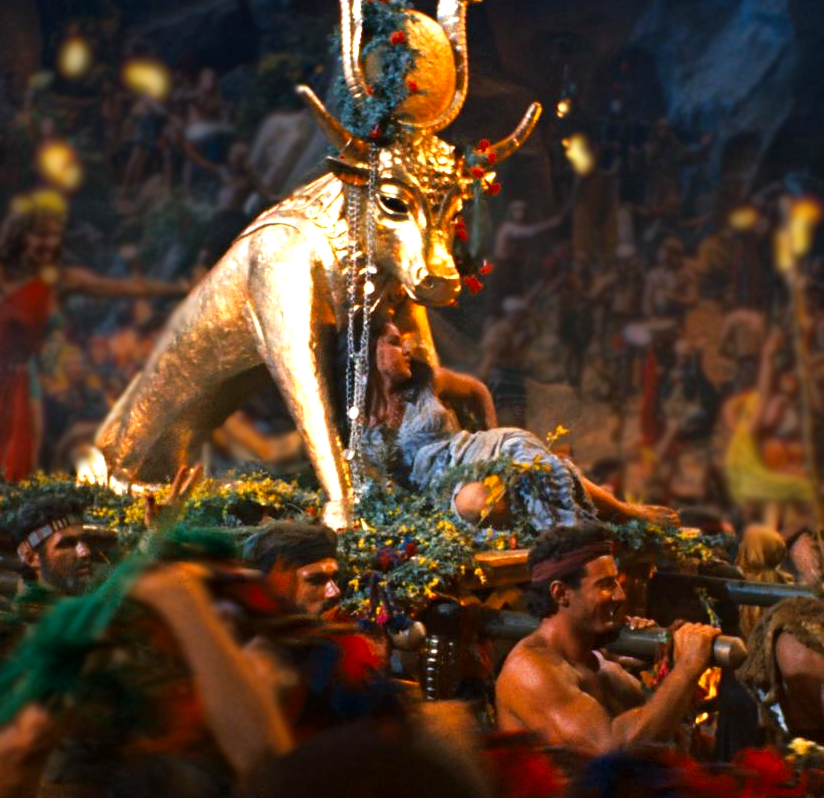
An idol is an idol is an idol, by any other name
Fr. Peck develops this argument by contrasting Incarnational Christianity with a Gnostic tendency to separate the spiritual from the material. Ancient Gnosticism treated material existence as inferior or as something from which the spiritual person must escape. Similar tendencies can reappear whenever Christianity is reduced to inward ideas, private spirituality, or an amorphous “God” detached from the concrete person of Jesus Christ.
The dogmatic icon resists this. It will not allow Christ to become merely an idea in the believer’s mind. It confronts us with a particular Person who was born in history, suffered under historical circumstances, died bodily, rose bodily, and ascended in the humanity He assumed.
Fr. Peck provocatively argues that idolatry includes not only worshiping a false god but misrepresenting the true God. The golden calf was idolatrous precisely because Israel attributed God’s saving work to a representation unworthy and untrue to Him. From this perspective, a Christianity that treats the incarnate Christ as though He were still a faceless, bodiless spirit risks liturgically obscuring the very event it verbally confesses.
The icon therefore says: the Incarnation has happened, and Christian worship must never behave as though it has not.
Matter Can Serve the Kingdom of God
Icons also follow from the Orthodox understanding of creation. Christianity is not salvation from materiality. God created the material world and called it good. The Son assumed flesh. Christ used water, bread, wine, oil, touch, spoken words, and physical gestures. The Christian hope is resurrection of the body, not escape from embodiment.
Wood and pigment are not divine, just as the paper and ink of a Gospel book are not divine. Yet created things can be consecrated and become instruments of the Church’s proclamation and prayer. Icons belong to the same sacramental vision in which creation is capable of bearing witness to grace.
The icon consequently points toward the transfiguration of creation. It does not merely record what a saint once looked like. Orthodox iconography portrays human existence oriented toward the Kingdom, bearing witness to what divine grace can accomplish in embodied human persons.
Veneration Is Not Adoration
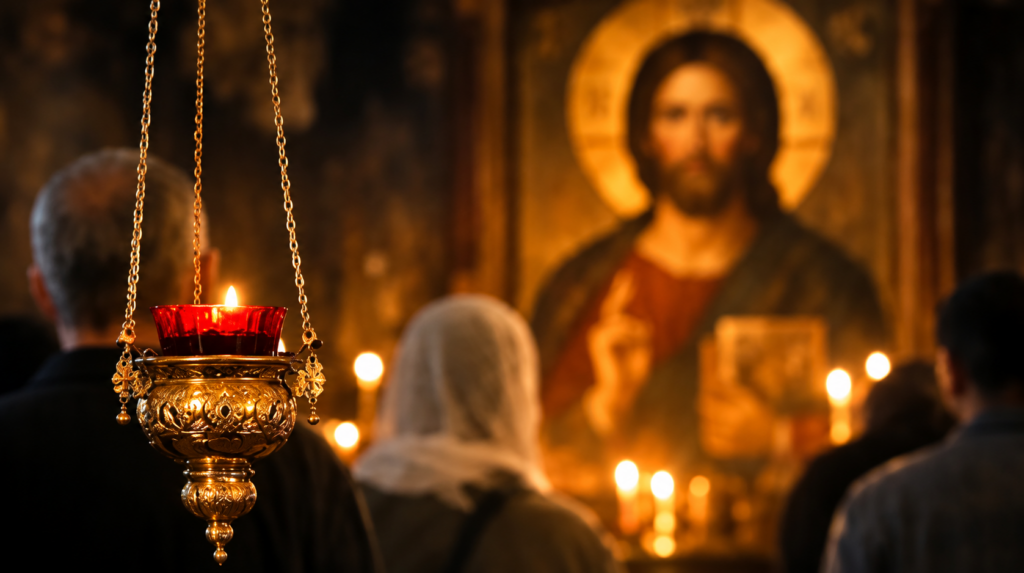
Orthodoxy distinguishes the honor shown to an icon from the worship that belongs to God alone. The Seventh Ecumenical Council affirmed that the honor offered to an image passes to its prototype. A Christian kissing an icon of Christ does not believe that wood and paint created the universe. The act is directed to Christ represented in the image.
This principle is familiar even in ordinary human relationships. Someone may kiss a photograph of a loved one without believing the paper is that person. The analogy is limited, because an icon belongs to the Church’s liturgical and dogmatic life, but it demonstrates that an outward act of honor toward an image need not terminate in the material object.
An idol arrests devotion at a false representation. A true icon does the opposite: it directs the believer beyond itself to the person represented.
Icons Are Dogmatic, Not Merely Decorative

Christ Not Made by Hands – a dogmatic icon
Fr. Peck makes another important distinction: an icon is not simply a “holy picture” intended to create a religious mood. Dogmatic iconography is governed by the truth it proclaims. An iconographer is not free to reinvent Christ according to fantasy, sentiment, fashion, or personal preference any more than a translator is free to rewrite Scripture while claiming fidelity to its meaning.
This helps explain the traditional character of Orthodox iconography. Its conventions are not merely aesthetic conservatism. They discipline the image so that it serves ecclesial memory rather than private invention. The icon is meant to bear witness to a received reality.
This becomes especially significant when considered alongside the Orthodox teaching about mental imagery in prayer.
Icons and the Rejection of Imaginary Prayer
At first glance there may seem to be a contradiction. Orthodox churches are filled with visual images, yet the Orthodox ascetical tradition repeatedly warns Christians not to manufacture mental pictures during prayer.
The essay “Mental Imagery in Eastern Orthodox Private Devotion,” by Fr. Sergei Sveshnikov, explains this distinction. Drawing on St. John Climacus, St. Ignatius Brianchaninov, St. Nilus of Sinai, St. Gregory of Sinai, and other Fathers, it describes the Orthodox practice of seeking stillness of mind rather than deliberately imagining scenes, visions, or appearances of Christ and the saints.
This is not hostility toward images. It is a rejection of self-generated images as substitutes for reality.
St. Ignatius makes the distinction particularly clear: holy icons awaken pious remembrance and place the worshiper consciously before the person represented, but they are not intended to stimulate imaginative fantasy. One may stand before an icon of Christ while keeping the mind free from invented pictures. There is, in his teaching, a profound difference between standing before the Lord and imagining the Lord.
This illuminates why icons are so important. The canonical icon is external to the worshiper’s private imagination. It is received from the Church. Its form is disciplined by tradition and dogma. Instead of asking the believer to construct a personalized Jesus internally, it directs attention toward the historical and ecclesially confessed Christ.
The contrast is therefore not “images versus no images.” It is received icon versus self-created fantasy; ecclesial confession versus private invention; objective Incarnation versus subjective visualization.
Orthodox caution regarding mental imagery and Orthodox insistence upon icons thus arise from the same spiritual principle: prayer should be grounded in truth rather than fantasy.
Icons Make the Communion of Saints Visible
The Incarnation makes the icon of Christ possible; sanctification explains icons of His saints. The saints are not alternative saviors or independent sources of holiness. They show what the grace of Christ accomplishes in human beings.
Their icons also confess that death does not destroy the Church. The Church on earth worships in communion with the Mother of God, apostles, martyrs, hierarchs, monastics, and all who are alive in Christ. The iconostasis and the icon-covered walls of an Orthodox temple make this ecclesiology visible.
An empty church wall can be aesthetically attractive, but the Orthodox temple is making a theological statement. The congregation does not worship as an isolated collection of individuals. It stands within the communion of the whole Body of Christ.
Why “Requires” Is the Right Word
To say that Orthodoxy requires icons does not mean that a Christian deprived of icons by imprisonment, poverty, persecution, or circumstance cannot pray. Nor does it mean that possession of an icon mechanically produces grace.
The necessity is doctrinal.
Orthodoxy cannot reject icons in principle without damaging its confession of the Incarnation. If Christ truly became visible, His humanity is depictable. If matter can be sanctified, material creation can serve the Gospel. If the saints are alive in Christ, their images can testify to the communion of the Church. If Christian prayer must resist private fantasy, the received dogmatic icon offers an objective ecclesial witness rather than an imagined Christ constructed by the individual.
This is why the restoration of icons in 843 is celebrated as the Triumph of Orthodoxy. What was vindicated was not a preference for religious artwork but a whole vision of Christianity: God truly became man; matter is not the enemy of salvation; the Church receives rather than invents the faith; and human beings are called to transfiguration in Christ.
Conclusion
Orthodox Christianity requires icons because it requires the consequences of the Incarnation.
The icon declares that God did not save humanity from a safe distance. The Word entered material creation, took flesh from the Virgin Mary, acquired a human face, lived in history, suffered, died, rose, and remains forever Jesus Christ, fully God and fully man.
At the same time, Orthodox spirituality refuses to replace this objective Christ with an internally manufactured image. The Church places the dogmatic icon before the believer while teaching the believer not to manufacture fantasies within the mind. These two practices are complementary. Both defend reality against illusion.
The icon therefore stands at the intersection of Christology, worship, asceticism, and Christian anthropology. It proclaims that the invisible has become visible without ceasing to be divine; that matter can be sanctified without becoming God; that honor can pass through an image to its prototype; and that the Church’s faith is received from a concrete historical revelation rather than invented by individual imagination.
The icon is not necessary because Christians need religious decoration. It is necessary because the Word became flesh. Once God has shown us His human face in Jesus Christ, the Church must never worship as though that face had never appeared.
Sources
Fr. John A. Peck, “The Necessity of Iconography and the Idolatry of Gnosticism.”
Fr. Sergei Sveshnikov, “Mental Imagery in Eastern Orthodox Private Devotion.”
The Seventh Ecumenical Council (Nicaea II, 787).
St. John of Damascus, On the Divine Images.