A Christian who first enters an Orthodox church may notice the icons, chanting, incense, and ancient prayers. Yet the most consequential Orthodox Protestant differences do not begin with outward appearance. They concern a more basic question: where does the Christian faith come from, and who has the authority to guard and hand it on?
Many Protestants love Christ, read Scripture seriously, pray faithfully, and seek to obey God. Orthodox Christians should recognize that with gratitude, not contempt. At the same time, Christian unity cannot rest on goodwill alone. Truth matters because Christ matters. The differences between Orthodoxy and Protestantism shape how Christians read the Bible, worship God, receive grace, understand salvation, and belong to the Church.
Orthodox Protestant Differences in Authority
The central question is authority. Most Protestant traditions hold that Scripture is the final and sufficient rule of faith. Church councils, historic creeds, pastors, and theological traditions may be helpful, but they stand beneath the Bible and can be corrected by it.
Orthodoxy also confesses that Scripture is inspired, authoritative, and the word of God. The Church does not place human tradition above the Bible. Rather, Orthodoxy receives Holy Scripture within Holy Tradition: the living faith given by Christ to the apostles, preached by them, embodied in worship, defended by the councils, and preserved in the life of the Church.
This is not an appeal to vague customs or to whatever happened to develop over the centuries. Apostolic Tradition has content. It is the faith confessed in the Creed, proclaimed in the Scriptures, prayed in the liturgy, and taught by the saints. The same Church that received and recognized the books of the New Testament continues to interpret them.
For an evangelical Christian, this can feel unfamiliar. He may ask, “Why not simply follow the Bible?” The Orthodox answer is that no one reads the Bible from nowhere. Every reader brings assumptions about baptism, communion, predestination, church government, and even which books belong in the Bible. The question is not whether Christians interpret Scripture. The question is whether interpretation remains rooted in the historic Church or becomes subject to the judgments of individuals and new movements.
The Church: Invisible Believers or a Visible Body?
Many Protestants speak of the Church primarily as the invisible fellowship of all true believers, spread across denominations and known perfectly to God alone. Local congregations matter, but they may be understood as voluntary gatherings of Christians rather than as expressions of one visible, sacramental Church.
Orthodoxy confesses one, holy, catholic, and apostolic Church. This Church is visible as well as spiritual. It has bishops, priests, deacons, sacraments, worship, discipline, and a concrete continuity with the apostles through ordination. Christ did not leave behind a collection of religious ideas for independent groups to reconstruct. He established a Body.
That claim requires humility. The Church includes sinners, and Orthodox parishes are not museums for perfect people. Clergy can fail. Parishioners can be immature. But human weakness does not erase Christ’s promise to preserve His Church. The Orthodox Christian does not place faith in the moral flawlessness of leaders. He trusts the Lord who remains faithful to His Body.
This also explains why Orthodox Christians cannot regard denominational division as normal or desirable. Protestants often differ on baptism, the Eucharist, women’s ordination, divorce, sexuality, salvation, and church authority while still affirming a broad Christian identity. Orthodoxy does not treat every disagreement as equally serious, but it does see division in doctrine and communion as a wound requiring healing, not a permanent arrangement to celebrate.
Scripture and the Life of Tradition
Orthodox Christians read the Bible constantly. Scripture fills the services of the Church. Psalms, prophets, Gospels, and apostolic writings shape the daily cycle of prayer and the yearly feast cycle. A faithful Orthodox life is never less biblical because it is traditional. It becomes more deeply biblical by receiving the Scriptures as the Church has prayed and proclaimed them.
The difference often appears in interpretation. A Protestant Bible study may begin with the question, “What does this passage mean to me?” A better Protestant study will ask what the author intended and how the passage fits the whole Bible. Orthodoxy asks those questions too, but adds another: how has the Church understood and lived this passage through the centuries?
This does not mean that every statement by every ancient writer carries equal weight. The fathers are not a second Bible. Nor does Orthodoxy forbid careful study of history, language, or literary context. It means that private novelty is not a virtue. If an interpretation overturns the Church’s settled confession of Christ, it should be viewed with profound caution.
Sacraments Are Not Mere Symbols
Among the most practical Orthodox Protestant differences is the meaning of the sacraments. In many Protestant communities, baptism and communion are ordinances commanded by Christ and rich in symbolism, but they do not ordinarily convey grace in the strong sacramental sense Orthodoxy teaches.
Orthodoxy calls baptism a true participation in Christ’s death and resurrection. In baptism, a person is united to Christ, washed, clothed in Him, and received into His Church. Chrismation seals the newly baptized with the gift of the Holy Spirit. This is why Orthodox baptism is not merely a public testimony that follows an inward conversion. It is a sacramental beginning of new life.
The Eucharist is equally decisive. Orthodox Christians confess that the bread and wine truly become the Body and Blood of Christ by the Holy Spirit. We do not reduce Holy Communion to a bare memorial, even though remembrance is part of what Christ commanded. At the Lord’s Table, the Church receives the real gift of Christ Himself.
This teaching can sound difficult to those formed by low-church Protestantism. Yet it reflects the seriousness of Scripture’s language about baptism, the cup, the bread, and communion in Christ. It also reflects the earliest Christian worship. Orthodoxy does not attempt to explain the mystery away. We receive it with reverence.
Salvation: More Than a Legal Declaration
Protestant teaching on salvation varies widely. Some traditions emphasize justification by faith alone as God’s legal declaration that the believer is righteous because of Christ. Others place stronger emphasis on sanctification, discipleship, and participation in God’s life. Orthodox Christians can affirm that no one earns salvation and that every good gift comes by grace. We are saved because of Jesus Christ, not because we have accumulated religious merit.
But Orthodoxy speaks of salvation more broadly than acquittal in a courtroom. Salvation is healing, restoration, forgiveness, victory over death, and union with God. The fathers often call this theosis: by grace, human beings are brought into communion with God and made increasingly like Him. We never become divine by nature. We become partakers of the divine life through Christ.
Faith, then, is not mere agreement with true statements. It is living trust and faithful union with Christ. Grace does not leave a person unchanged. Prayer, fasting, repentance, almsgiving, confession, and the Eucharist are not attempts to purchase God’s favor. They are the medicine and training of a life being healed.
Here, language matters. Some Protestants hear Orthodox teaching and assume that it denies assurance or preaches salvation by works. That is not accurate. Others may hear Protestant language about faith alone and assume it rejects obedience. That also can be unfair. Still, real differences remain. Orthodoxy resists separating salvation from transformation, or justification from the lifelong work of becoming holy.
Worship Forms the Christian
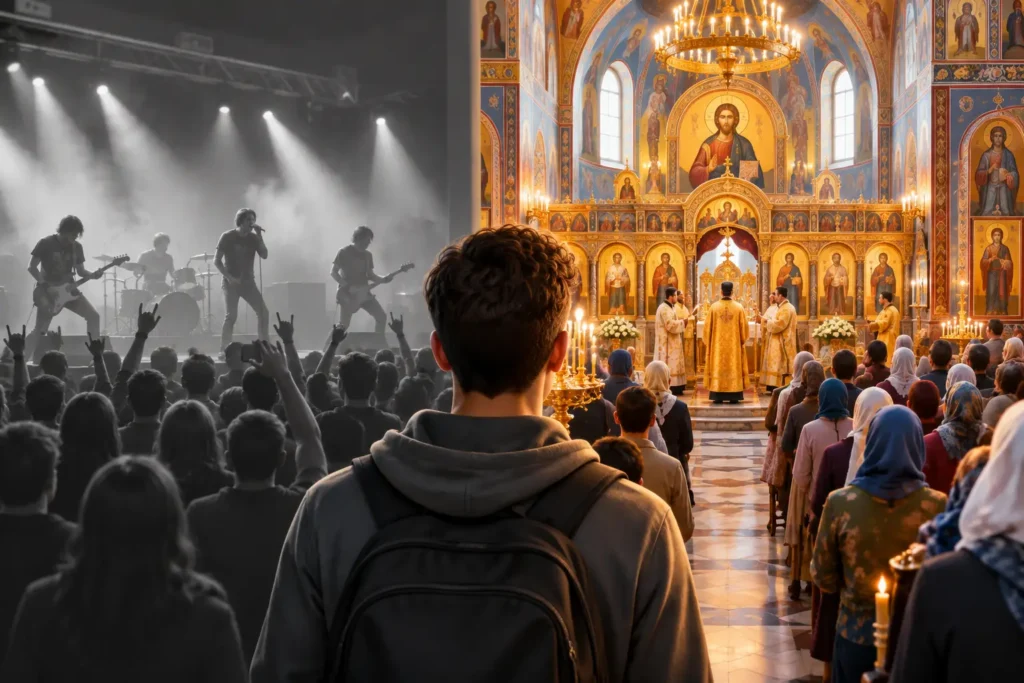
Protestant worship ranges from formal liturgy to a simple gathering centered on preaching and contemporary music. Orthodox worship follows a received liturgical pattern, centered on the Eucharist and shaped by Scripture, prayer, feast days, fasting seasons, and the communion of saints.
The issue is not whether one musical style feels more moving. Feelings can be real, but they are not a sufficient test of truth. Orthodox worship is designed to form the whole person over time. The body stands, bows, crosses itself, fasts, and receives. The ears hear Scripture and prayer. The eyes encounter icons that proclaim the Incarnation. The calendar teaches Christians to inhabit the life of Christ rather than treating faith as an hour on Sunday.
This can be demanding. Orthodox services are not built around convenience, and the Church’s fasting disciplines require real adjustment. But a faith that asks little often forms little. The Orthodox way calls Christians into a stable rhythm of repentance, worship, and joy.
How to Explore These Differences Honestly
If you are a Protestant considering Orthodoxy, do not begin by collecting arguments merely to win a debate. Begin with prayer, the Gospels, and an honest willingness to ask whether the Christianity of the apostles can be found as a continuous life rather than only as a set of recovered doctrines.
Visit an Orthodox service more than once. Attend with patience. Much of the meaning becomes clear through repetition, instruction, and participation in the Church’s calendar. Ask direct questions about Scripture, salvation, Mary, icons, saints, baptism, and the Eucharist. A serious parish will not pressure you into a quick decision or hide the cost of Orthodox discipleship.
For those in the west Phoenix area, All Saints of North America Orthodox Church offers a deliberate path of catechism and preparation for inquirers, not a hurried religious transaction. Come prepared to learn, pray, and test what you hear against the fullness of the Christian faith.
The goal is not to trade one religious preference for another. Christ calls us beyond spiritual consumerism and doctrinal confusion into His Church, where truth is confessed, sins are forgiven, and a new life is patiently formed.