A funeral director may ask a family to choose burial or cremation before they have even had time to grieve. The question can feel practical, financial, and urgent. But for an Orthodox Christian, the question “is cremation Orthodox?” is not merely about a method of handling a body. It concerns what the Church confesses about the human person, the body, death, and the resurrection of the dead.
The Orthodox Church calls her faithful to burial, not cremation. This is a clear and ancient Christian practice, rooted in Scripture, the life of the saints, and the Church’s worship. At the same time, grieving families deserve pastoral care, not cold answers. If cremation has already taken place, or if a family faces difficult circumstances, speak with your priest promptly. The Church does not abandon people in sorrow.
Is Cremation Orthodox?
In the ordinary course of Christian life, cremation is not Orthodox. Orthodox Christians are buried because the body is not viewed as a disposable possession or an empty shell. The body belongs to the person. It was created by God, sanctified in baptism, nourished by the Holy Mysteries, and called to rise again when Christ returns.
This does not mean that God lacks the power to raise someone whose body has been cremated, lost at sea, destroyed in war, or consumed by fire in an accident. God raises the dead. His power is not limited by the condition of human remains. The issue is not whether resurrection remains possible. The issue is what the Christian community deliberately chooses to do with the body entrusted to its care.
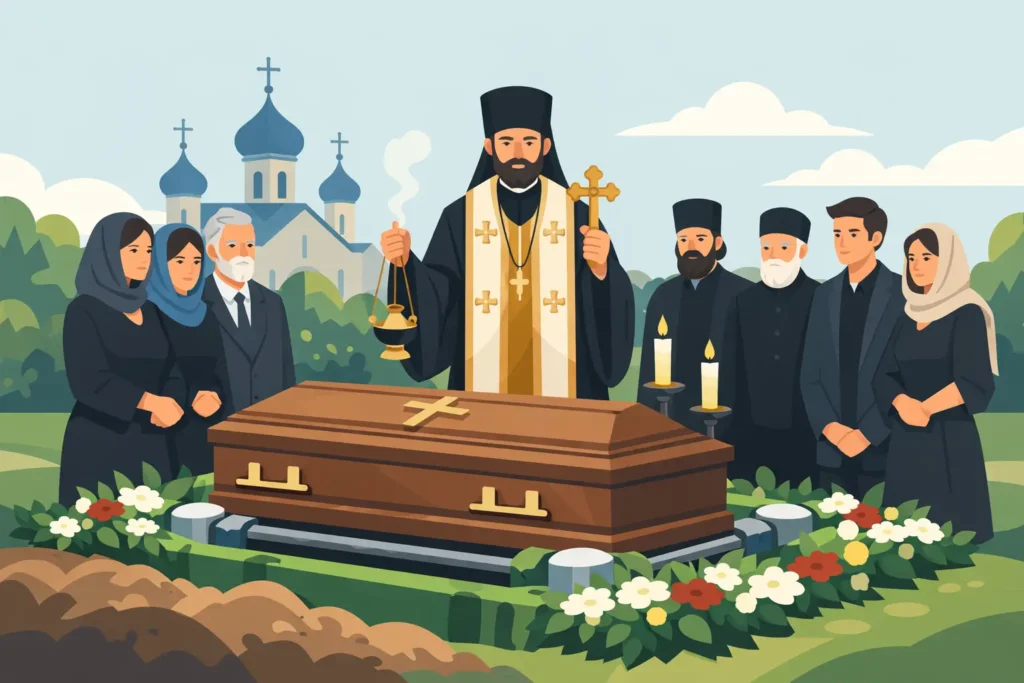
Christian burial is an act of faith. The Church lays the body in the earth as one who plants a seed, awaiting the resurrection. This is why Orthodox funeral prayers speak so directly and so hopefully about death. We mourn because death is an enemy, a rupture introduced into human life through sin. Yet we mourn with confidence in Christ, who trampled down death by death and opened the way to eternal life.
Why the Orthodox Church Buries the Dead
The Church’s practice begins with Christ Himself. After His crucifixion, His body was taken down from the Cross, wrapped, and placed in a tomb. The Myrrh-bearing Women went to His tomb to anoint His body. On the third day, they encountered the reality that stands at the center of Christian faith: Christ is risen.
The Church also follows the consistent biblical pattern of honoring the dead through burial. Abraham buried Sarah. The patriarchs were buried. John the Baptist’s disciples took his body and buried it. The early Christians continued this practice, often at real cost. In periods of persecution, Christians cared for the bodies of martyrs and buried them with reverence, confessing that these bodies had become temples of the Holy Spirit.
Burial therefore says something that words alone cannot say, and cremation denies. It proclaims that the body is worthy of honor. It resists the idea that death has the final word. It places the deceased in the care of God while the Church prays, “Memory eternal.”
Cremation developed in many settings for reasons that were not always neutral toward Christian belief. At times it was promoted as a rejection of bodily resurrection, Christian burial, or the Church’s understanding of the person. Today, people choose cremation for many different reasons, including cost, convenience, family custom, environmental concerns, or pressure from others. Those motives may not include hostility to Christianity. Even so, the Orthodox Church retains burial because it visibly expresses the faith she has received.
The Body Is Not an Object
Modern culture often treats the body as something we own, alter, use, and discard according to personal preference. Orthodoxy speaks differently. We are not souls temporarily trapped in bodies, nor are we bodies without spiritual meaning. The human person is a unity of body and soul.
At baptism, the body is washed and anointed. At chrismation, it receives the seal of the gift of the Holy Spirit. In the Eucharist, the faithful receive Christ’s Body and Blood. The body participates in prayer through standing, kneeling, fasting, making the sign of the Cross, and venerating holy things. Christian burial honors that whole life of sanctification.
This is also why the Church does not frame burial as a sentimental preference. It is part of Christian discipleship. How we prepare for death teaches our children, comforts our families, and bears witness to neighbors who may never enter a church except at a funeral. There is no place in Orthodox tradition for cremation.
What Happens If Someone Is Cremated?
A person should never assume that cremation places someone beyond God’s mercy. No human being is beyond the compassion of Christ. Families who are carrying grief, regret, confusion, or conflict need the prayers of the Church and the wise care of a priest.
Still, voluntary cremation can affect what funeral rites may be offered. Orthodox practice normally does not permit the full funeral service for a person who knowingly chose cremation apart from compelling circumstances. Particular decisions belong to the bishop and the priest serving under him. The Church does not treat sacred services as private ceremonies that can simply be adapted to any preference.
There are situations that require greater care. A person may have died without leaving instructions. Relatives who are not Orthodox may have made the decision. A family may have faced severe financial hardship, civil restrictions, military circumstances, or a death far from home. Someone may have been cremated before becoming Orthodox, or against his or her wishes. These circumstances matter. Do not rely on internet advice or make assumptions about what may be possible.
Call your parish priest as soon as death is near or has occurred. A priest can help the family understand the Church’s teaching, speak with a funeral home when needed, and guide the next faithful step. That conversation is far easier before final arrangements have been signed.
Practical Preparation for an Orthodox Burial (not cremation)
Preparing for death is not morbid. It is Christian sobriety. Every Orthodox believer should make his or her wishes known clearly, especially because family members may be overwhelmed when decisions must be made quickly.
Write down that you desire an Orthodox burial and not cremation, and tell your spouse, adult children, executor, or closest relative. Keep your parish priest’s contact information available. If possible, make arrangements that account for burial expenses rather than leaving your family to choose solely on immediate cost. A simple burial can be faithful and dignified. Christian burial does not require extravagance.
It is also wise to discuss arrangements with your priest before a crisis. Ask about the funeral service, the place of burial, memorial prayers, and customary practices in your parish. Orthodox Christians do not merely plan a disposal of remains. We prepare for the Church to accompany us in prayer from this life to the grave.
If a loved one is not Orthodox, do not use this teaching as a weapon in a family disagreement. Speak truthfully, but with patience. Your witness should reflect both conviction and love. A calm conversation now may spare your family a painful conflict later.
A Faithful Word for Grieving Families
Death forces questions that many people have postponed for years. It exposes whether faith is only an idea or a way of life. The Orthodox Church does not offer burial because she denies grief. She offers burial, not cremation, because grief is met by hope – not vague optimism, but hope in the crucified and risen Jesus Christ.If you are exploring Orthodoxy, let this teaching show you the Church’s coherence. The same Church that baptizes the body, blesses the body, and feeds the faithful with the Holy Mysteries also entrusts the body to the earth in prayer. Nothing about the human person is beneath God’s care.
And if your family is facing a death now, do not carry the burden alone. Speak with a priest, ask for prayer, and take one faithful step at a time. The Church stands beside the grave not to pretend that death is small, but to proclaim that Christ is greater.