The first surprise when you start reading the Church Fathers is that they do not sound like distant museum pieces. They speak about anger, prayer, marriage, money, suffering, repentance, the Eucharist, the demons, and the hard work of becoming holy. Their world was different from ours, but the human heart has not changed. The Church Fathers do not offer a religious hobby. They call us into the life of Christ as He has given it to His Church.
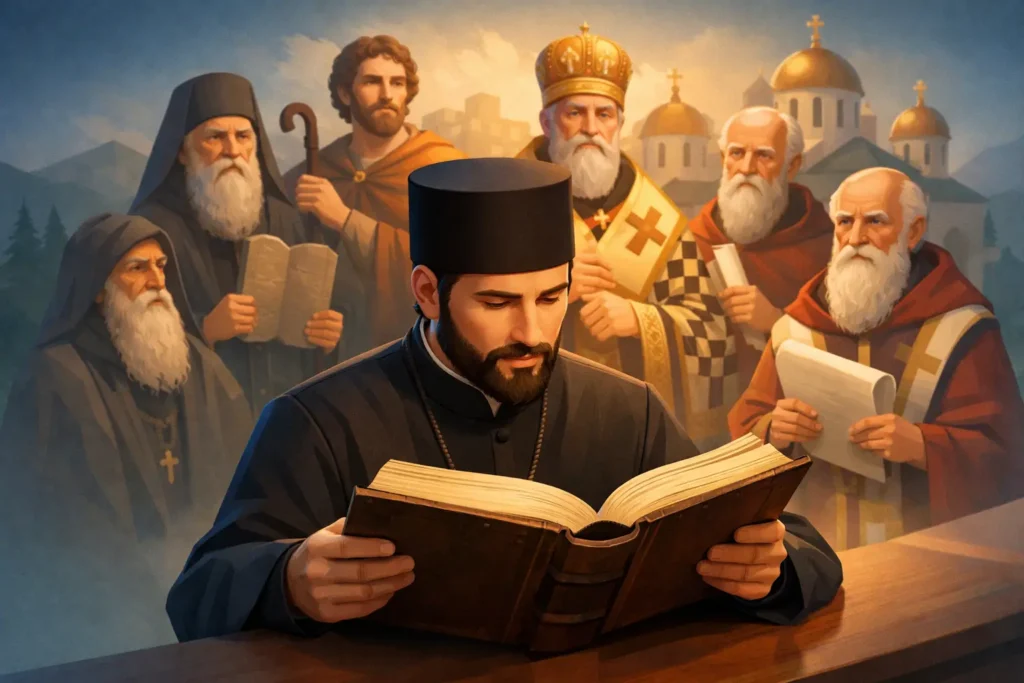
For an Orthodox Christian, reading the Church Fathers is not an attempt to locate private spiritual opinions from the past. It is an encounter with trusted witnesses to the apostolic faith. They learned the Scriptures in the Church, worshiped in the Church, defended the Church when false teaching threatened her, and often suffered for Christ. Their writings help us hear the Bible with the mind of the Church rather than with the assumptions of modern individualism.
Why Read the Church Fathers?
The Church Fathers teach us that doctrine and life belong together. St. Athanasius did not defend Christ’s full divinity as an academic exercise. If Christ is not truly God, he argued, then humanity cannot truly be saved and united to God. St. Basil the Great wrote about the Holy Spirit because the Church’s worship and baptism confess the Spirit as Lord. St. John Chrysostom preached with force because he wanted ordinary Christians to repent, forgive, give generously, and receive Holy Communion with fear of God and faith.
This is why reading the Church Fathers is especially valuable for Christians coming from fragmented backgrounds. Modern readers often inherit a faith divided between Bible study, personal experience, moral advice, and competing theological systems. The Fathers refuse that division. Scripture is read in worship. Theology leads to doxology. Repentance prepares a person for prayer. Love for the poor exposes whether our confession of Christ is sincere.
They also correct a common mistake: assuming that the earliest and most authentic Christianity must be whatever feels simplest to us. The Church Fathers show a historic Christian life that is sacramental, liturgical, ascetical, communal, and centered on the Incarnation of the Son of God. Their witness does not make every question easy, but it gives us solid ground beneath our feet.
Reading the Church Fathers as Members of the Church
The Church Fathers should not be approached as isolated authorities who can be made to support whatever position we already hold. A reader can pull one severe sentence from an ascetical homily, another sentence from a controversy, and create a distorted Christianity. The Church receives the Fathers together, within the fullness of her worship, councils, saints, and pastoral life.
That means prayer matters before reading. Begin simply: ask God to give you humility, repentance, and a desire for truth. Read a manageable section. Do not rush to extract a quotation for an argument. Ask what the passage reveals about God, what it exposes in your own heart, and how it directs you toward faithful participation in the Church.
It also means that context matters. Some Church Fathers wrote sermons for a particular congregation. Others answered specific heresies. Some addressed monks living under strict obedience, while others instructed parents, merchants, rulers, and the poor. Their words are not less true because they are particular. Yet we must understand whom they were addressing and why.
A good rule is this: let difficult passages make you more patient, not more confident that everyone else is wrong. If a text troubles you, bring the question to a priest or discuss it in a serious Orthodox study setting. The goal is not to tame the Church Fathers. It is to receive their medicine without misusing it.
Do Not Read for Arguments Alone
Many people first encounter the Church Fathers through online debates about Orthodoxy, Roman Catholicism, Protestantism, or the early Church. There is real value in knowing what the Fathers taught, especially when modern claims contradict the historic faith. But controversy alone can shrink their witness.
St. Ignatius of Antioch does speak clearly about the bishop, the Eucharist, and unity in the Church. St. Irenaeus does answer the Gnostics with apostolic Tradition. These things matter. But Ignatius was also walking toward martyrdom, longing to belong wholly to Christ. Irenaeus also presents salvation as humanity being restored and brought to maturity in the Son. Read the whole man, not only the sentence useful for a debate.
Let Scripture Lead the Conversation
The Fathers constantly quote and interpret Scripture. Their writing can feel unfamiliar because they see connections between passages that modern readers miss. They read the Old Testament as fulfilled in Christ, and they see the Church’s worship as shaped by the whole biblical story.
Keep a Bible open as you read. When a Father cites a psalm, a Gospel passage, or an apostolic epistle, read it in context. Over time, you will begin to recognize how the Church prays and understands Scripture. This is not a shortcut around careful Bible study. It is a school for learning to read the Bible as Orthodox Christians.
Where Should You Begin?
Start with writers whose works are clear, pastoral, and close to ordinary Christian life. There is no single sequence for every person. A catechumen may need an introduction to the apostolic faith; a longtime Orthodox Christian may need help with prayer or repentance. Read slowly enough that the words can become prayer and action.
St. Ignatius of Antioch is an excellent beginning because his letters are short, direct, and full of love for Christ and His Church. St. Polycarp’s letter to the Philippians offers simple, weighty exhortation to steadfast Christian life. The Didache, while not written by one of the Fathers in the usual sense, gives a valuable early picture of Christian moral formation, fasting, baptism, and worship.
For a fuller account of the faith, St. Irenaeus is indispensable. His language can require patience, but he shows the unity of Scripture and the beauty of God’s saving work. St. Athanasius’ On the Incarnation is often a fitting next step. Read it not merely to learn that Christ is God, but to see why the Word became flesh: to conquer death, heal corruption, and restore us to communion with God.
For practical preaching, many readers benefit from St. John Chrysostom. His homilies can be piercing. He will not let us admire Christian truth while ignoring our use of wealth, our speech, our treatment of family, or our indifference to neighbors in need. Receive that sharpness as the concern of a spiritual physician.
Later, readers may turn to St. Basil the Great, St. Gregory the Theologian, St. Ephrem the Syrian, St. Cyril of Alexandria, St. Maximus the Confessor, St. John of Damascus, and St. Isaac the Syrian. Do not treat this as a race. One deeply received homily may bear more fruit than fifty pages skimmed in haste.
A Simple Rule for Faithful Reading the Church Fathers
Set a modest rhythm that you can actually keep. Ten or fifteen minutes, a few times each week, is enough to begin. Read one short passage, mark what you do not understand, and return to it later. If a passage calls you to forgive someone, pray more carefully, restrain your tongue, attend the services, or confess a sin, then respond. The Church Fathers were written to be lived.
Avoid trying to construct a private rule of fasting, prayer, or asceticism from passages addressed to saints and monks. The Church Fathers honor discipline, but Orthodox discipline grows under obedience and pastoral care. A person with young children, demanding work, illness, grief, or a new life in the Church may need different counsel than a desert ascetic. The same medicine is not administered in the same measure to every soul.
Reading with others can also protect us from selective interpretation. At All Saints of North America Orthodox Church, serious formation does not end with information. Catechism, mystagogy, preaching, confession, and the services of the Church form one life. The Church Fathers belong naturally in that life because they continually direct us back to Christ in His Body.
Reading the Church Fathers Toward Repentance and Worship
The final test for reading the Church Fathers is not whether you can name more ancient authors or win more theological discussions. It is whether you become more faithful in prayer, more rooted in the Scriptures, more obedient to Christ, more merciful toward others, and more grateful for His Church.
The Church Fathers will sometimes comfort you. They will often confront you. Stay with them. Read with a Bible nearby, with humility in your heart, and with the Church’s worship shaping your imagination. Then their words will not remain on the page. By God’s mercy, they will help lead you home to the living faith they confessed.