If you have never attended an Orthodox service, the first question is usually simple and honest: what happens during Divine Liturgy? You hear chanting, see processions, notice people crossing themselves and venerating icons, and quickly realize this is not a casual gathering built around a sermon. The Divine Liturgy is the worship of the Church before the throne of God, the offering of praise and thanksgiving, and the sacramental participation of Christ’s people in His life.
For a newcomer, that can feel both beautiful and unfamiliar. The good news is that the service has a clear shape. It is not random, and it is not meant to entertain. Every prayer, hymn, and action belongs to the Church’s received worship and teaches the faith even as it expresses it.
What happens during Divine Liturgy in simple terms
At the broadest level, the Divine Liturgy moves in two major parts. First, the Church hears the Word of God in prayers, psalms, hymns, and Scripture readings. Then the Church offers the Eucharist and receives Holy Communion. Orthodox worship does not separate doctrine from prayer or belief from sacrament. What the Church confesses, she also sings, proclaims, and receives.
This means the Divine Liturgy is not only something you watch. It is something the faithful enter with body and soul. We stand, we listen, we pray, we repent, we give thanks, and we are drawn into communion with Christ and with one another.
The service begins before you realize it
Before the public portion of the Liturgy starts, the priest prepares the bread and wine in a service called the Proskomedia, or preparation. This usually happens quietly before the people arrive or while they are gathering. The bread and wine are set apart for the Eucharist, and prayers are offered for the living and the departed.
That hidden preparation matters. Orthodox worship does not begin at the moment the congregation becomes aware of it. The Church comes before God with reverence and order. Much of the Christian life is like that – what is offered publicly is sustained by prayerful preparation that others may never see.
When the Liturgy formally opens, the deacon or priest blesses the Kingdom of the Father and of the Son and of the Holy Spirit. That opening is not decorative language. It announces where the Church stands. The Divine Liturgy is participation in the Kingdom of God made present among His people.
The Liturgy of the Word
The first major portion is often called the Liturgy of the Catechumens, because in earlier centuries this was the part in which those preparing for baptism would especially participate. It includes a series of petitions, antiphons, hymns, and readings from Scripture.
Very early in the service, you will hear repeated petitions for peace, for the Church, for the world, for travelers, for the suffering, and for our salvation. This teaches something essential about Orthodox prayer. The Church does not pray only for private needs. She intercedes for all and brings the whole world before God.
The Little Entrance follows, when the Gospel book is carried in procession. This is not mere ceremony. It is a visible confession that Christ comes to His people and that His Gospel stands at the center of the Church’s life. Soon after, the Trisagion Hymn is sung: “Holy God, Holy Mighty, Holy Immortal, have mercy on us.” The congregation joins the worship of heaven, not by imagination alone, but through the actual liturgical life of the Church.
Then come the Scripture readings, usually an Epistle and a Gospel reading appointed for the day. In many Protestant settings, the sermon is the clear climax of the service. In Orthodox worship, preaching matters, but it is not isolated from the larger act of worship. The homily serves the Gospel proclaimed and prepares the people to respond faithfully.
Some parishes preach immediately after the Gospel. Others place the sermon later. Either way, the sermon is meant to be an explanation of the apostolic faith, not a motivational talk or a running commentary on current events.
What happens during Divine Liturgy after the readings
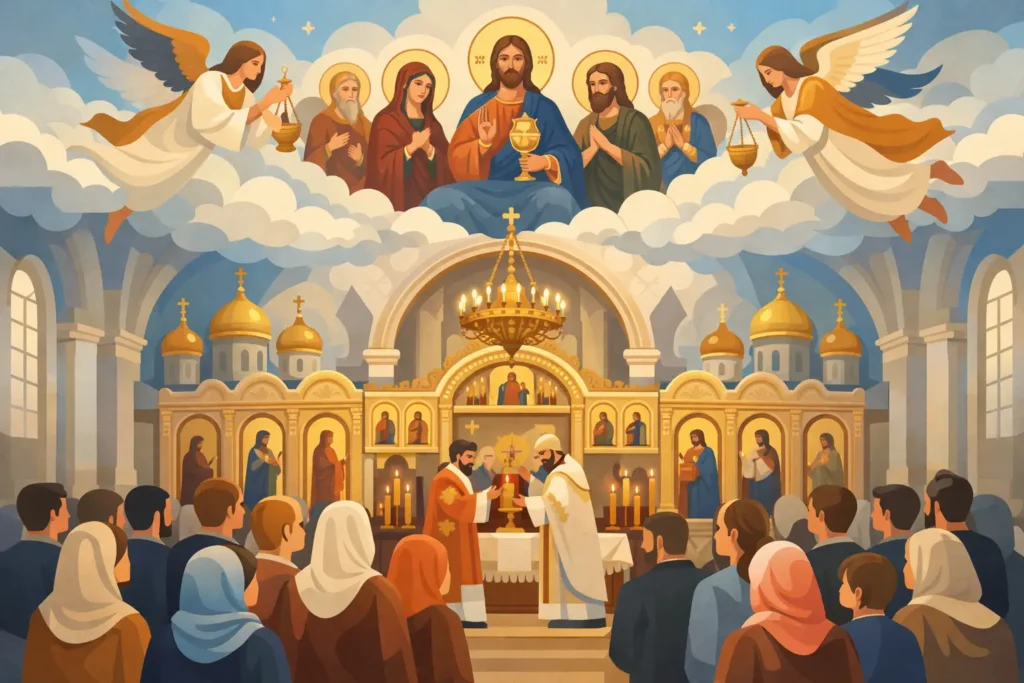
After the readings and prayers, the service turns toward the Eucharistic offering. This transition is marked by the Cherubic Hymn and the Great Entrance, in which the prepared bread and wine are carried in solemn procession and placed on the altar.
This is one of the most striking moments for visitors. It may appear symbolic only, but in Orthodox understanding it is more than pageantry. The Church is offering herself and all creation to God in thanksgiving. The gifts of bread and wine represent not only material things but the life of the people gathered before Him.
At this point the call to spiritual attention becomes more intense. The faithful are urged to lay aside worldly cares, not because earthly responsibilities are unimportant, but because the Kingdom demands our full attention. Divine worship requires repentance, humility, and inward watchfulness.
Then comes the kiss of peace in some form, followed by the Creed. This is fitting and necessary. Before approaching the Eucharist, the Church confesses the true faith openly. Communion is not detached from doctrine. Unity at the chalice is unity in Christ, and therefore unity in the apostolic faith.
The Eucharistic prayer
The central prayer of the Divine Liturgy is the Anaphora, the great prayer of offering and thanksgiving. Here the priest gives thanks for creation, redemption, the saving work of Christ, His Cross, Tomb, Resurrection, Ascension, and Second Coming. The Church remembers what God has done, but this remembrance is not bare recollection. It is liturgical participation in the once-for-all saving work of Christ.
The people respond throughout with prayerful attentiveness. In the Orthodox Church, liturgy is never a private act performed by the clergy while everyone else watches. The priest serves in and for the assembled Church, and the people answer with Amen, Lord have mercy, singing, and reverent participation.
During this prayer, the Church asks the Holy Spirit to come upon us and upon the gifts here offered, making the bread and wine to be the Body and Blood of Christ. This is the mystery of the Eucharist. Orthodoxy does not treat Holy Communion as a mere symbol or mental reminder. It is truly communion in Christ, given for the life of the world and for the sanctification of His people.
This is why preparation matters. The Eucharist is medicine of immortality, but it is not casual. Orthodox Christians prepare through prayer, fasting, repentance, and confession as needed. Love and mercy are central, but familiarity must never replace reverence.
Holy Communion
After the Lord’s Prayer and final prayers of preparation, the clergy receive Communion first, then the faithful come forward. In many Orthodox parishes, only baptized and chrismated Orthodox Christians who are spiritually prepared receive the Eucharist. Visitors are still welcome to attend, pray, and observe, but they should not approach for Communion unless they have been instructed and blessed to do so.
For some visitors, this can feel difficult at first. Yet the practice is not meant to exclude casually or to punish outsiders. It protects the truth of Communion itself. To receive from the chalice is to confess full unity of faith and life with the Orthodox Church. Honest boundaries are kinder than vague gestures that hide real differences.
If you are visiting, you may still come forward at the end for blessed bread if that is the parish custom. More importantly, you can begin learning, asking questions, and entering the life of the Church in an orderly way.
The dismissal and the life that follows
The Divine Liturgy ends with thanksgiving, blessing, and dismissal. But in a deeper sense, it does not simply end. The faithful are sent back into the world to live what they have received. Worship is not an isolated religious event placed next to ordinary life. It is the center from which Christian life flows.
That is why Orthodox Christianity cannot be reduced to attending services occasionally or appreciating beautiful traditions from a distance. The Divine Liturgy calls for a whole life – prayer at home, repentance, fasting, confession, almsgiving, catechesis, and steady obedience to Christ in His Church.
For many who first visit an Orthodox parish, the Liturgy answers a hunger they could not quite name. It is solemn without being cold, ancient without being dead, and doctrinal without being abstract. It is the worship of the living God handed down in the Church through the centuries.
If you are asking what happens during Divine Liturgy, the truest answer is this: heaven and earth meet in the worship of Christ’s Church, and we are invited to repent, believe, and be changed. Come with attention. Come with patience. In time, what first seems unfamiliar becomes recognizable as home.