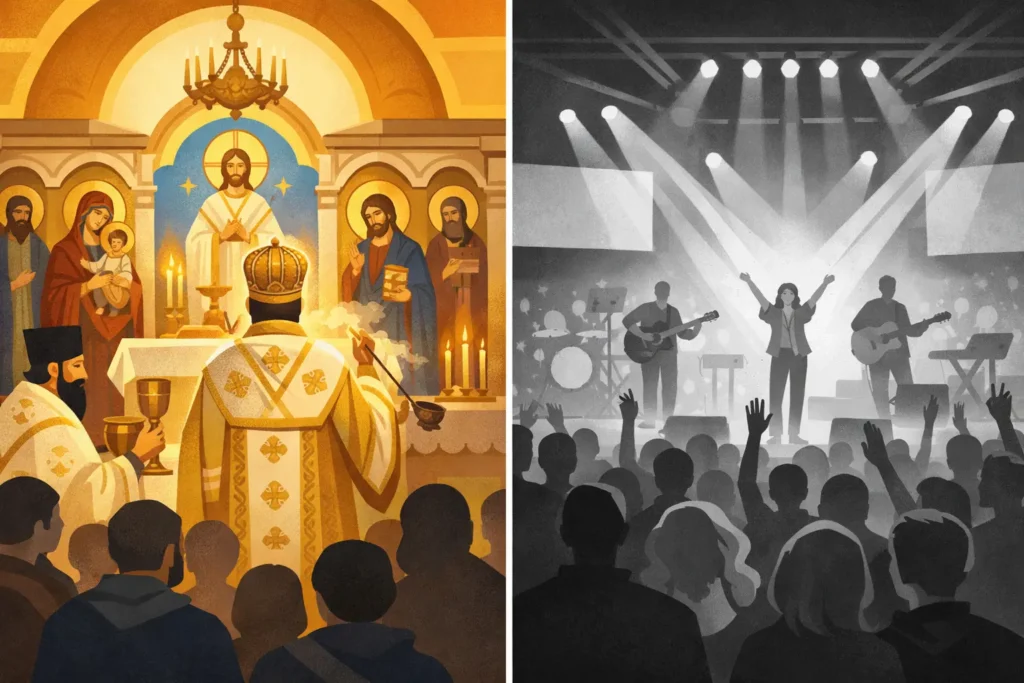
A visitor may notice the difference before a single word is explained. In Orthodox vs evangelical worship, one service may begin with incense, chanting, icons, and prayers received across centuries; the other may begin with a welcome, contemporary music, and an extended sermon. These differences are real, but they are not merely matters of taste, personality, or musical preference. They arise from different convictions about what the Church is, what happens in worship, and how Christians are formed in Christ.
For many evangelicals seeking the ancient faith, the first experience of an Orthodox Divine Liturgy can feel both beautiful and unfamiliar. The right question is not simply, “Did this feel meaningful to me?” It is, “What is the Church offering to God, and what is God giving to His people?”
Orthodox vs Evangelical Worship: The Central Difference
Orthodox worship is first and foremost the worship of God by the Church. The congregation does not gather to produce a religious experience or to hear an encouraging message, though believers are certainly encouraged and instructed. The Church gathers to enter the heavenly worship described in Scripture, joining the angels and saints in the praise of the Holy Trinity.
The Divine Liturgy is therefore received, not invented. Its prayers, readings, hymns, gestures, and sacramental actions have developed organically within the life of the Church, preserving the apostolic faith through the centuries. The priest does not function as a presenter managing a service. He stands before God on behalf of the people and serves the mysteries entrusted to the Church.
Evangelical worship is diverse. A small Bible church, a Reformed congregation, a Baptist church, and a large non-denominational gathering may differ significantly from one another. Still, many evangelical services are organized chiefly around preaching, congregational singing, prayer, and a call to personal faith and obedience. Their form often allows greater freedom in music, length, language, and order.
This flexibility can make a service immediately accessible. Yet it also places great weight on the preferences, abilities, and theological commitments of a particular pastor, worship leader, or congregation. Orthodox worship is intentionally less dependent on individual creativity because it belongs to the whole Church, not to one generation or local ministry.
Worship as Participation, Not Observation
A common misunderstanding is that Orthodox worship is something the priest and choir do while everyone else watches. In truth, the Liturgy calls every person to active participation. The people answer prayers with “Amen,” confess the faith, sing hymns, bow, make the sign of the cross, fast, feast, and prepare to receive Holy Communion. Even silence has a purpose. The body is involved because human beings worship God with body and soul.
Evangelical services also seek participation, often through singing, spoken responses, prayer, and attentive listening to Scripture. In many settings, however, participation is measured largely by emotional engagement, verbal expression, or response to the sermon. Orthodox Christianity does not dismiss emotion. Repentance, joy, gratitude, and awe belong in worship. But the Church does not make intensity of feeling the measure of faithfulness.
There will be Sundays when a believer feels deeply moved, and Sundays when he is distracted, weary, or burdened. The Liturgy remains the Liturgy. It teaches Christians to offer praise even when their feelings are weak, trusting that God is faithful and present.
The Place of Scripture and Preaching
Evangelical Christians rightly value the Bible and often know it well. A serious evangelical sermon may offer careful exposition, direct application, and a call to repentance. Orthodox Christians should recognize this strength without hesitation.
The difference is that in Orthodox worship, Scripture is not limited to the sermon. The Psalms, Old Testament passages, Epistle, Gospel, antiphons, prayers, and hymns are saturated with the words and images of the Bible. The Church does not simply read Scripture in the Liturgy. She prays Scripture and interprets Scripture through the whole pattern of worship.
The homily remains important. It should proclaim Christ, explain the Gospel, confront sin, and guide the faithful in the Christian life. But it is not the center of the Divine Liturgy. The Eucharist is. The sermon prepares the people to receive and live the Word of God, while the Liturgy brings the Church before the Lord in thanksgiving and communion.
This can be a significant adjustment for evangelicals accustomed to evaluating a church primarily by the quality or length of its preaching. Orthodox Christians should desire sound preaching, but no gifted preacher can replace the sacramental life of the Church.
The Eucharist Changes the Shape of Worship
The clearest difference between Orthodox and evangelical worship concerns Holy Communion. Orthodox Christians confess that the bread and wine become the true Body and Blood of Christ. This is not a bare symbol, a spiritual illustration, or a memorial separated from reality. It is a holy mystery in which Christ truly gives Himself to His people.
Because the Eucharist is central, Orthodox worship is ordered toward preparation, offering, consecration, and communion. The prayers of the faithful, the confession of the Creed, the Great Entrance, and the thanksgiving all move toward this sacramental encounter. Communion is not an optional addition at the end of a service. It is the fulfillment of the Church’s gathered worship.
Evangelicals hold different views. Some celebrate the Lord’s Supper frequently and reverently. Others observe it monthly, quarterly, or on special occasions, usually understanding it as a memorial meal and public testimony of faith. The frequency and meaning of communion reveal a deeper question: does Christ give grace through the sacramental life of His Church, or are the ordinances primarily acts of obedience that symbolize grace already received?
Orthodoxy answers clearly: God acts. He forgives, heals, sanctifies, and unites His people to Himself through the mysteries He has given to the Church. This is why Orthodox Christians prepare for Communion with prayer, fasting, repentance, and confession as needed. The Cup is not casual. It is life-giving and holy.
Beauty, Reverence, and the Whole Person
Icons, candles, incense, vestments, chanting, and processions sometimes trouble visitors from evangelical backgrounds. They may worry that such things distract from a simple faith in Jesus Christ. Yet Orthodox worship uses material things precisely because the Son of God truly became man. The Incarnation matters for worship.
The Orthodox Church does not worship wood, paint, or incense. Icons honor Christ, His Mother, and His saints, directing the faithful toward the reality of the Kingdom. Incense expresses prayer rising before God. Beauty is not decoration added to make worship impressive. It is an offering to the God who created a good world and who will transfigure creation.
Evangelical worship often favors simplicity, directness, and cultural accessibility. There can be a genuine desire to remove barriers so that the Gospel is heard plainly. That concern should not be mocked. At the same time, simplicity can become thinness when worship loses a sense of sacred time, holy space, and the communion of saints.
Orthodox worship asks more of the worshiper. It requires patience, attention, humility, and repeated attendance. A newcomer may not understand every hymn or action on the first visit. But worship is not designed to be mastered in one hour. It forms Christians slowly, week after week, through the rhythms of feasts, fasts, Scripture, prayer, confession, and Communion.
From Personal Preference to Churchly Faith
The deepest question is not whether a person prefers hymns or praise music, a shorter service or a longer one, formal language or conversational speech. Preferences change. The Church’s calling is to hand down the faith once delivered to the saints and to make disciples who can endure suffering, resist sin, love their neighbor, and remain faithful to Christ.
For an evangelical visitor, it is wise to come more than once. Stand where you are comfortable, follow what you can, and do not be embarrassed by what you do not yet understand. Do not receive Communion until you have been received into the Orthodox Church, but do bring your questions. A serious parish will welcome honest inquiry while also speaking plainly about the faith.
At All Saints of North America Orthodox Church, those exploring Orthodoxy can find a clear path for learning the faith rather than pressure to make a hurried decision. The goal is not to trade one church style for another. It is to come home to the apostolic Church, to be formed by her worship, and to offer your whole life to Jesus Christ.
If Orthodox worship feels unfamiliar, give it the attention you would give any great and holy thing. Return, listen, pray, and ask the Lord for truth. The Church’s worship is not asking you to be entertained. It is inviting you to stand before the living God.