If you were raised Roman Catholic or are now comparing ancient Christian traditions, the question of Orthodox vs Catholic salvation is not academic. It touches confession, baptism, communion, repentance, assurance, and the whole shape of the Christian life. People often ask which Church “teaches salvation by grace” as though one side believes in grace and the other does not. That is the wrong starting point.
Both the Orthodox Church and the Roman Catholic Church confess that salvation is impossible apart from the grace of God in Jesus Christ. Neither teaches that man saves himself. The real difference is found in how salvation is described, how grace is understood in the life of the believer, how sin and justification are framed, and how the Church participates in the healing of the human person.
Orthodox vs Catholic salvation: the shared ground
Before speaking about differences, it is only honest to name the common inheritance. Both Orthodox and Catholics confess the Holy Trinity, the divinity of Christ, His death and resurrection, the need for baptism, the importance of the sacraments, the reality of sin, the coming judgment, and the necessity of holy living. Both reject the idea that a bare intellectual belief, with no repentance or transformation, is enough.
That matters because many comparisons are distorted from the beginning. The issue is not whether Catholics care about holiness or whether Orthodox believe in grace. The issue is deeper. What, exactly, is salvation? Is it primarily a legal declaration, the healing and deification of the person, or some combination described in different categories? The answer shapes everything else.
What salvation means in the Orthodox Church
In Orthodox teaching, salvation is not reduced to a moment, a courtroom verdict, or a change of status before God considered in isolation. Salvation is union with Christ. It is forgiveness, certainly, but it is also healing, sanctification, illumination, and glorification. The classic Orthodox word many inquirers encounter is theosis, which means participation in the life of God by grace.
This does not mean that human beings become gods by nature. It means that through Christ, by the Holy Spirit, man is restored to communion with God and transformed. Salvation is therefore deeply relational and medicinal. Sin is not only guilt. It is also corruption, disorder, bondage, and death. Christ saves us not merely by declaring us forgiven, but by conquering death and making us alive in Him.
That is why Orthodox spiritual life is so comprehensive. Baptism, chrismation, the Eucharist, confession, fasting, prayer, almsgiving, and perseverance are not add-ons to a finished transaction. They are how life in Christ is lived and received. Grace is not treated as a created religious substance handed out in measurable portions. It is the living action and gift of God Himself.
How Catholic theology usually frames salvation
Roman Catholic theology also teaches that salvation begins in grace and requires the life of the sacraments. Catholic doctrine rejects the idea that man earns salvation apart from God. In that respect, the difference should not be exaggerated into caricature.
Still, Catholic theology developed with categories that are often more juridical and systematic than those used in Orthodoxy. It speaks with precision about justification, merit, satisfaction, mortal and venial sin, purgatory, and the treasury of merits. Not every Catholic explains these themes the same way, and many devout Catholics live a deeply sacramental and reverent life. But as a theological system, Roman Catholicism tends to define salvation with sharper legal distinctions and later scholastic formulations.
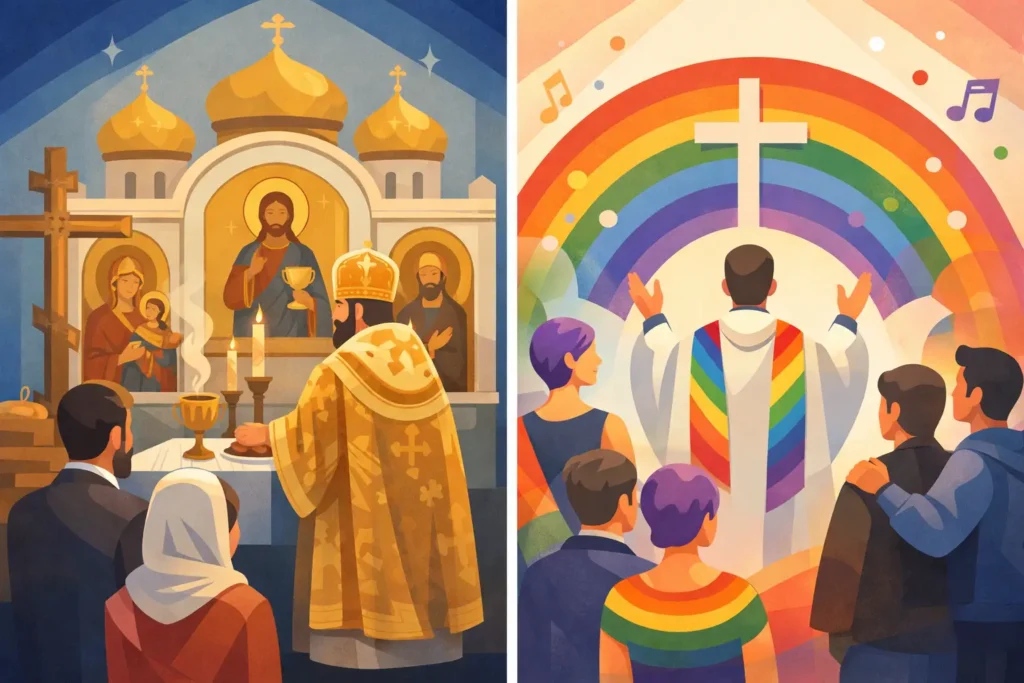
Orthodoxy does not deny legal language in Scripture. Scripture plainly speaks of judgment, forgiveness, righteousness, and acquittal. The difference is one of emphasis and integration. The Orthodox Church refuses to let legal categories dominate the mystery of salvation. The central image is not simply the courtroom. It is also the hospital, the battlefield, the family, the temple, and the wedding feast.
Orthodox vs Catholic salvation and justification
This is one of the most important areas of confusion. Many western Christians hear the word justification and assume the entire doctrine of salvation stands or falls on a single definition. Orthodoxy does not isolate justification that way.
The Orthodox Church affirms that man is justified by the grace of God through Jesus Christ, not by autonomous human effort. But Orthodoxy does not usually separate justification from sanctification as sharply as later western theology often does. To be put right with God is not merely to receive an external declaration. It is to be brought into Christ and renewed.
Catholic theology, especially after centuries of western doctrinal development, also includes renewal within justification more readily than many Protestants do. So in some comparisons, Orthodoxy and Catholicism can sound closer to one another than either sounds to evangelical Protestantism. Even so, Orthodoxy remains cautious about the kinds of definitions that emerged in the Latin West when they seem to force divine mysteries into overly narrow conceptual systems.
For the Orthodox Christian, salvation is a lifelong path of repentance and communion. That does not deny the need for clarity. It simply means clarity must be faithful to the fullness of Scripture and the worshiping life of the Church.
The question of original sin and inherited guilt
Another difference appears in how the fall of Adam is understood. Orthodox Christians speak more often of ancestral sin than original guilt. We inherit a fallen world, mortality, corruption, and a weakened condition inclined toward sin. We do not teach that every person bears Adam’s personal guilt in the same way later western theology sometimes described.
That distinction matters for salvation. If the human problem is framed chiefly as inherited guilt requiring legal satisfaction, then the doctrine of salvation will develop in one direction. If the human problem is framed as death, corruption, and alienation healed by Christ’s incarnation, death, and resurrection, the doctrine develops differently. Orthodoxy insists on the second without denying that guilt is real. We sin and bear responsibility for our sins. But death itself is the enemy Christ destroys.
Sacraments, grace, and the life of repentance
Both traditions take the sacraments seriously, but Orthodox Christianity places them within the life of deification and repentance rather than within a tightly defined system of grace accounting. Baptism is real union with Christ. The Eucharist is truly His Body and Blood. Confession restores the penitent through Christ’s mercy. These are not symbols of an already completed inward reality. They are means by which God acts.
At the same time, Orthodoxy avoids mechanical thinking. The sacraments are not magic. One may receive outwardly and remain inwardly resistant. Salvation requires synergy, not in the sense of equal partnership with God, but in the sense that man must cooperate with grace rather than resist it. God acts first. God sustains. God saves. Yet man is not a machine.
This is one reason many serious inquirers find Orthodoxy both demanding and liberating. It does not offer cheap assurance. It offers a life of repentance in Christ, inside His Church, nourished by grace, with real hope and real accountability.
Where the papacy affects the question of salvation
At first glance, the papacy may seem like a separate issue from salvation. In practice, it is not. Rome’s claims about universal jurisdiction and doctrinal authority shape the whole structure of the Church and therefore the administration and understanding of the means of salvation. Roman Catholicism teaches that you must believe in papal infallibility in order to be saved.
Orthodoxy holds that salvation is given in the Church through apostolic faith, sacramental life, and communion in the truth. The Church is conciliar, episcopal, and sacramental. Rome’s later claims are not viewed as harmless administrative developments. They are seen as doctrinal innovations with consequences for the faith itself.
That does not mean Orthodox Christians believe every Roman Catholic is insincere. It means the Orthodox Church speaks plainly about where the fullness of the apostolic faith is preserved.
How to approach this question honestly
If you are weighing Orthodox vs Catholic salvation, do not stop at internet arguments or isolated proof texts. Ask what each Church believes man is, what sin is, what grace is, what the Church is, and what Christ came to do. You will find that salvation cannot be separated from the whole doctrinal and liturgical life of the Church.
For many who come from Roman Catholic or evangelical backgrounds, the decisive discovery is this: Orthodoxy does not present salvation as a spiritual accounting problem needing better theory. It presents salvation as communion with the living God through Christ in the Holy Spirit, within the worshiping and ascetical life of the Church. That vision is ancient, scriptural, and demanding in the best sense.
If you are inquiring seriously, take your time, pray carefully, and test what you hear against the life of the historic Church. Read the Scriptures with the Fathers. Attend the services. Speak with a priest. Ask hard questions. Truth does not fear examination, and the path to Christ is not served by slogans.
For those in the western Phoenix area who are sorting through these questions carefully, a serious Orthodox parish should help you move from comparison to formation. At some point, the question is no longer only what Orthodoxy teaches about salvation, but whether you are ready to be healed within the life of the Church.
Welcome home.