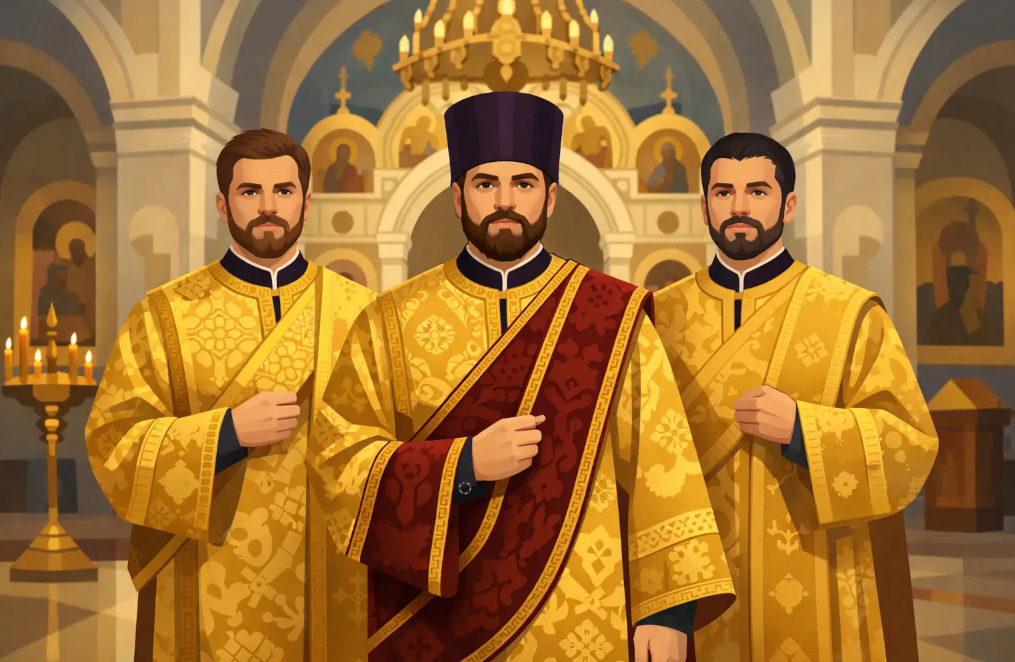
When you enter an Orthodox service, you may first notice the priest at the altar, and not the deacons. Yet Orthodox deacons give voice to much of the Church’s prayer: calling the faithful to peace, directing our attention to the Lord, censing the holy gifts and the people, and proclaiming the Gospel. Their ministry is neither decorative nor a lesser version of the priesthood. It is a distinct ordained service of Christ and His Church.
The word deacon comes from the Greek word diakonos, meaning servant or minister. This name reaches back to the apostolic Church. In Acts 6, the Apostles set apart men of good reputation as deacons, full of the Holy Spirit and wisdom, to serve the practical needs of the growing Christian community. The Church has always understood diaconal ministry as a visible expression of Christ, who came not to be served, but to serve.
What Orthodox deacons Are Called to Do
An Orthodox deacon serves under the authority of his bishop and alongside the priesthood. He does not act independently. At every Divine Liturgy, the deacon’s petitions, commands, and liturgical movements show this ordered life of the Church: Christ is the Head; the bishop guards the faith and unity of the local Church; priests shepherd communities in communion with their bishop; and deacons serve the bishop, clergy, and faithful.
At the altar, the deacon assists the priest and helps order the worship of the Church. He prepares for the services, censes the church, leads the litanies, reads the Gospel when appointed, and assists with the distribution of Holy Communion. His voice often carries the petitions of the entire congregation: for the Church, civil authorities, those who travel, the sick, the suffering, and the salvation of all.
These actions teach something essential. Orthodox worship is not a private experience built around personal preference. It is the gathered people of God offering prayer with one voice. The deacon helps the faithful pray attentively, bodily, and together.
His service also extends beyond the iconostasis. A deacon may visit the sick, bring pastoral care to those in need, help coordinate works of mercy, teach when blessed, and assist in the careful catechesis of those entering the Church. The particular shape of this work depends on the needs of a parish and the blessing of the bishop. A deacon in a large parish may have extensive responsibilities in charity and formation; another may primarily assist at the services. The calling remains the same: faithful service in obedience to Christ.
Orthodox deacons Are Not “Assistant Priests”
Modern Christians often assume that every ordained minister performs the same role at a different level. Orthodoxy does not see the clergy that way. Bishop, priest, and deacon share in one apostolic ministry, but each order has its own proper work.
A priest presides at the Eucharist on behalf of his bishop. He receives confessions, anoints the sick, baptizes, crowns marriages, and offers the prayers and blessings entrusted to the priesthood. A deacon does not consecrate the Eucharist, pronounce absolution in confession, or preside over the Mysteries as a priest does. He serves and assists. This is not a limitation to overcome. It is the beauty of a Church in which every calling has a real purpose and no ministry exists for personal status.
The deacon’s liturgical role makes this plain. He calls the people to pray, but the priest offers the prayer. He prepares the gifts, but the priest offers them. He proclaims the Gospel, but he does so with the blessing of the priest or bishop. Orthodox clergy do not compete for prominence. They receive a ministry and give an account for how they have carried it.
This distinction also protects the faithful from confusion. The Church does not invent ministries to match cultural expectations or fill organizational gaps. She receives her order from the apostles and preserves it as part of the life handed down in Christ.
Service Requires Character Before Skill
The first qualifications for a deacon are spiritual and moral, not public speaking ability or administrative talent. Scripture instructs that deacons must be reverent, truthful, self-controlled, and tested. A man may know the services well and still not be ready for ordination. The Church looks for humility, sound faith, a stable life, and a demonstrated willingness to serve without seeking recognition.
This matters because a deacon stands before the people in worship. His conduct either strengthens or weakens the Church’s witness. He must guard his speech, his family life, his financial integrity, and his personal prayer. Ordination is not a reward for years of attendance. It is a fearful responsibility.
Some Orthodox deacons are unmarried, while others are married. A married man may be ordained if his marriage took place before ordination and meets the Church’s requirements. Once ordained, a clergyman does not marry or remarry. These disciplines are not arbitrary rules. They call clergy to a life of faithfulness, stability, and undivided accountability before God.
Why the deacon Matters in Parish Life
A healthy parish does not treat the deacon as a liturgical accessory. His ministry reminds everyone that worship and mercy belong together. The same deacon who intones prayers for the hungry, suffering, and departed should help form a parish that remembers them in concrete ways. The same man who calls us to “attend” in the Divine Liturgy should encourage attentive Christian living after the dismissal.
For the laity, this offers a needed correction. Service in the Church is not reserved for ordained men. Every Orthodox Christian has received gifts to offer: prayer, hospitality, almsgiving, teaching children, visiting the lonely, preparing meals, caring for the temple, and bearing one another’s burdens. The deacon does not replace the service of the faithful. He helps call it forth, organize it, and keep it connected to the worship of God.
This is especially important for those coming from religious backgrounds where church life feels either highly professionalized or almost entirely informal. Orthodoxy gives us neither a religious performance nor a loose volunteer association. It gives us a Body. The bishop, priest, deacon, reader, chanter, altar server, godparent, parent, catechumen, and longtime parishioner each stand before God with responsibilities. No one is unnecessary.
How to Receive the deacon’s Ministry
If you are new to Orthodox worship, do not worry if the deacon’s movements or petitions seem unfamiliar at first. Listen carefully. The litanies teach you how the Church prays. They move from peace and salvation to the needs of the world, the local parish, those in suffering, and our own repentance. When the deacon says, “Let us pray to the Lord,” the faithful answer, “Lord, have mercy.” This is not background noise. It is the prayer of the whole Church.
Receive his direction with the same reverence you bring to the service itself. When he calls you to stand attentively, bow your heads, or depart in peace, he is helping order a common act of worship. If you need pastoral counsel, preparation for confession, or guidance about becoming Orthodox, speak first with the priest unless the parish has directed you otherwise. The deacon may be a valuable source of help, but the Church’s order gives clarity and protects souls.
At All Saints of North America Orthodox Church, those exploring the faith can encounter this ordered life firsthand: not as a relic of the past, but as living apostolic Christianity. Come with questions, pray with attention, and allow the Church’s worship to teach you. In the deacon’s service, you will see a quiet but powerful truth: greatness in the Kingdom of God is found in faithful service to Christ and His people.