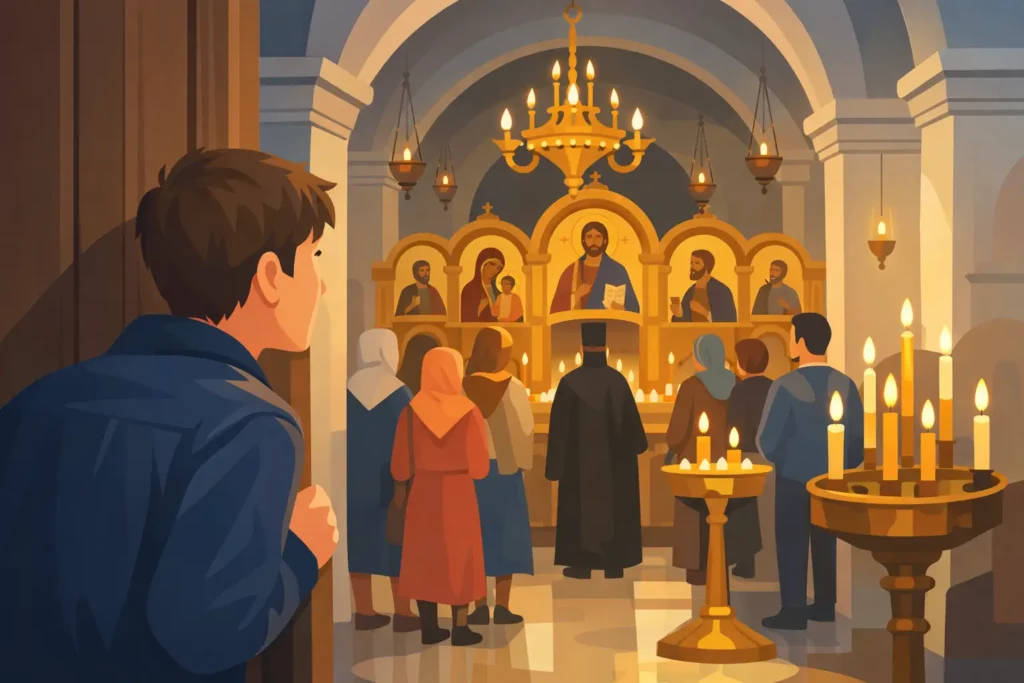
The first thing you may notice is that Orthodox church worship does not feel arranged for the visitor. The prayers are ancient, the icons are everywhere, and much of the service is sung. That can be disorienting at first, especially if you come from a Protestant, evangelical, Roman Catholic, Mormon, or non-Christian background. But if you are wondering how to visit an Orthodox church, begin here: you do not need to understand everything before you enter. Come with humility, stand before God, and allow the Church to pray.
Orthodox church worship is not a performance or a lecture. It is the Church’s offering of praise to the Holy Trinity, joining heaven and earth in the worship described in Scripture. Visitors are welcome, but the proper posture is not that of a consumer evaluating a service. It is that of a guest entering a holy place.
How to Visit an Orthodox church With Reverence
Before you arrive, check the parish schedule and make sure you know whether you are attending Vespers, Matins, the Divine Liturgy, or another service. For a first visit, the Sunday Divine Liturgy is usually the clearest introduction to the parish gathered for worship. Arrive ten to fifteen minutes early if possible. This gives you time to enter quietly, find a place, and avoid the pressure of arriving in the middle of a reading or prayer.
Wear modest, clean clothing. Orthodox church parishes do not generally expect visitors to own special attire, and customs vary somewhat from one parish to another. Men should avoid shorts, sleeveless shirts, or clothing that is overly casual. Women should dress modestly and may choose to wear a head covering, though this practice varies by parish and is not normally required of a first-time visitor. The point is simple: dress in a way that reflects respect for the presence of God and does not call attention to yourself.
When you enter the temple, you may see people lighting candles, kissing icons, or making the sign of the cross. These are acts of prayer, not religious theater. You are free to observe quietly. Do not feel pressured to imitate a practice you do not understand. A sincere visitor is never dishonored for standing attentively and learning.
If you are unsure where to go, ask a greeter or parishioner, “Is this my first time here. Where should I stand?” Orthodox people are accustomed to helping newcomers, though they may not always recognize immediately that someone is visiting. Most will gladly point you toward service books, restrooms, a place for children, or someone who can answer questions after the service.
What to Expect During the Divine Liturgy in an Orthodox church
The Divine Liturgy is full of Scripture. You will hear Psalms, prayers, litanies, an Epistle reading, and a Gospel reading. You will hear the name of Jesus Christ proclaimed repeatedly. The service may last longer than many modern church services, often around ninety minutes to two hours, depending on the parish and feast day.
There may be few or no pews. Traditionally, Orthodox Christians stand for much of worship, though chairs are available for those who need them. Sit when you need to sit. No one should feel ashamed for caring for an injury, illness, pregnancy, disability, or small child. At the same time, standing when you are able helps you enter the physical discipline of Orthodox prayer.
You will see people make the sign of the cross at various moments. In Orthodox church practice, this is normally done from forehead to chest, then right shoulder to left shoulder. You do not need to copy every movement around you. If you make the sign of the cross, do so prayerfully rather than mechanically. If you do not, simply stand respectfully.
The icons may be unfamiliar if you were taught that all religious images are idols. The Orthodox church does not worship wood and paint. We honor the persons depicted because Christ truly became man, and because His saints belong to Him. An icon is a confession of the Incarnation: the invisible God has made Himself known in Jesus Christ.
Do not worry about following every word
A service book can be helpful, but do not let it become a source of anxiety. The Liturgy is not a test. Listen for repeated phrases, especially “Lord, have mercy,” “Grant this, O Lord,” and the prayers to the Father, Son, and Holy Spirit. Let the words settle into you over time.
Many visitors try to decide after one service whether they “liked” Orthodoxy. That is understandable, but it is not always a useful measure. The first Liturgy may feel beautiful, confusing, solemn, crowded, or all of those things at once. Give yourself permission to return. Orthodox worship reveals itself by participation and patient attention, not by a quick first impression.
Orthodox church Communion, Blessed Bread, and Other Boundaries
The clearest practical boundary for visitors concerns Holy Communion. In the Orthodox Church, receiving Communion is the sacramental expression of full unity in faith and life with the Church. Therefore, only baptized and chrismated Orthodox Christians who have prepared under the guidance of their priest receive the Holy Gifts.
This is not a judgment against visitors or a claim that they are unwelcome. It is a serious confession of what the Eucharist is: the Body and Blood of Christ, given to those who are united to Him in the Orthodox Church. If you are not Orthodox, remain in your place during Communion and pray quietly. No explanation is required.
After Communion, some parishes distribute blessed bread, often called antidoron. In many Orthodox church parishes, visitors may receive it as a sign of hospitality. Wait and follow the direction given by the priest or another parish member. If you are uncertain, simply ask.
You may also see parishioners approach the priest at the end of the service for a blessing. Visitors are usually welcome to approach, introduce themselves, and receive a blessing. You might say, “Father, this is my first visit,” or “Thank you for receiving me.” That is enough. A good priest will not demand that you explain your entire spiritual history at the altar rail.
Bring Children and Ask Honest Questions
Families should not wait until their children can be perfectly quiet before visiting. Children belong in the worshiping life of the Church. They may wiggle, whisper, cry, or need to step outside. Parents should guide them with patience, but they should not assume that ordinary childhood noise means they do not belong.
After the service, stay for fellowship. ASONA offers a potluck coffee hour! This is often the best time to meet people and ask basic questions. Ask what service you attended, where to begin reading about Orthodoxy, or whether the parish has an inquirer class. Avoid treating one parishioner as the final authority on every theological question. For substantial questions about doctrine, conversion, marriage, baptism, confession, or personal spiritual struggles, speak with the priest. You’ll even receive a special gift just for first-time visitors.
If you live in the west Phoenix area, including Surprise, Peoria, Glendale, Sun City, Buckeye, or nearby communities, a parish such as All Saints of North America Orthodox Church can provide more than a single visit. A serious Orthodox parish offers a path of worship, catechism, pastoral conversation, and formation for those who are ready to inquire carefully.
If you are considering becoming Orthodox
Do not rush toward a label, and do not expect a private study project to replace life in the Church. Orthodoxy is received through worship, instruction, repentance, and sacramental life. The path may include a period of inquiry, formal catechism, and then baptism or chrismation, depending on your background and the judgment of the priest.
Bring your real questions. Ask about the authority of the Church, the saints, Scripture and Tradition, salvation, confession, the Virgin Mary, fasting, and the sacraments. Orthodox Christianity does not fear serious questions. But it does ask more than intellectual agreement. It calls every person to repentance, faithfulness, and a life ordered around Christ.
If the Lord is drawing you toward His Church, the next faithful step is not to master every custom, but to keep showing up, praying honestly, and receiving careful guidance from those entrusted to shepherd souls. Come once with reverence. Return with patience.