 Parish membership is not a religious subscription, a name added to a database, or a convenient place to attend on major feast days. In the Orthodox Church, membership means being received into a concrete Eucharistic community and accepting the discipline, worship, teaching, and mutual responsibility of life in Christ. This guide to parish membership is for those who are seeking a true Orthodox home, whether you are an inquirer, a catechumen, a newly received Orthodox Christian, or an Orthodox believer transferring from another parish.
The question is not merely, “Where do I prefer to attend?” It is, “Where am I being called to be formed, corrected, nourished, and sent forth in faithfulness?” A parish is where that work becomes personal.
What Parish Membership Means
The Church is not an association of like-minded people. She is the Body of Christ, gathered around the bishop and his clergy, confessing the apostolic Faith and receiving the Holy Mysteries. A parish is the local expression of that one Church. To belong to a parish is to belong to a particular people, under pastoral care, with real obligations toward God and neighbor.
Membership normally includes regular participation in the Divine Liturgy and the feast-day cycle, confession as directed by one’s priest, faithful preparation for Holy Communion, financial stewardship, prayer, service, and a willingness to learn. These are not separate programs competing for your time. They are parts of one Christian life.
This does not mean every member has identical abilities or responsibilities. A parent caring for small children, an elderly parishioner with limited mobility, and a person working an unpredictable schedule may participate differently. The standard is not public busyness. It is repentance, faithfulness, and an honest desire to order one’s life toward Christ.
Before You Seek Membership
If you are not yet Orthodox, do not feel pressure to pretend that you are further along than you are. Come, pray, listen, and ask serious questions. Attend the services with reverence, even when much of what you see is unfamiliar. Orthodox worship is not designed to be grasped in one visit. It is received over time through participation, instruction, and prayer.
For inquirers from Protestant, Evangelical, Roman Catholic, Mormon, Muslim, or secular backgrounds, the first task is not choosing a label. It is learning what the Orthodox Church actually teaches. Orthodoxy is not simply ancient Christianity with more ceremony. It is the fullness of the apostolic Faith, preserved in doctrine, worship, sacramental life, and holy living.
A serious parish will provide a defined path for learning. Catechism should address Scripture, the Holy Trinity, the person and work of Christ, salvation, the Church, the saints, the Theotokos, prayer, fasting, the Mysteries, and the moral life. It should also give you room to ask difficult questions without treating truth as negotiable.
At All Saints of North America Orthodox Church, those exploring the Faith can encounter a long-established catechetical process, pastoral guidance, and ongoing instruction that continues after reception into the Church. This matters because baptism or chrismation is a beginning, not graduation.
A Guide to Parish Membership: The Usual Path
The practical details of membership differ somewhat by parish and jurisdiction, so your priest should guide the process. Still, the ordinary path has a recognizable shape.
Begin by worshiping consistently
Visit more than once. Attend the Divine Liturgy regularly enough to learn the rhythm of the parish. If possible, experience Vespers, feast days, and Holy Week before making a final decision. Sunday morning alone gives a real encounter with Orthodox worship, but the wider cycle reveals more fully how the Church sanctifies time.
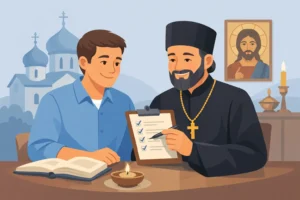
Introduce yourself to the priest or a designated parish leader. Be straightforward about your background and your hopes. If you are coming from another Orthodox parish, say so. If you are married, have children, have been previously baptized, or have questions about prior sacramental experiences, share that early. Clear communication helps the clergy provide sound pastoral care.
Receive the instruction appropriate to your situation
Those outside the Orthodox Church ordinarily enter a period of catechumenate before baptism or chrismation. The length is not a test of intelligence and should not be treated as a bureaucratic delay. The catechumenate allows a person to learn the Faith, examine his life, establish habits of worship and prayer, and discern his commitment with sobriety.
Orthodox Christians transferring from another canonical parish may not need catechism in the same form, but they still need to be known. A priest may ask about your previous parish, sacramental status, family circumstances, and spiritual needs. This is not suspicion. It is pastoral responsibility.
Be received into the Church, if necessary
For those becoming Orthodox, reception is determined by the Church’s pastoral and canonical practice under the guidance of the priest and bishop. It may involve baptism, chrismation, confession of faith, or another form of reception, depending on the person’s background. Do not attempt to settle these questions through internet debates. Bring your history honestly to the clergy and receive their direction with humility.
After reception, new Orthodox Christians should expect continued mystagogy – instruction in the mysteries they have entered. The Creed may now be familiar, but its meaning must become woven into prayer, family life, work, speech, and repentance.
Establish your parish membership formally
A parish may ask members to complete registration information, provide sacramental records where applicable, and make a stewardship commitment. These practical steps are not the heart of membership, but they serve the life of the parish. The clergy need to know who is under their care, and the parish needs the means to sustain worship, mercy, education, and hospitality.
If you are transferring, it is wise to leave your former parish honorably. Speak with your previous priest when possible, settle any concerns directly, and avoid carrying resentment into a new church home. A new parish cannot heal every wound immediately, but it can become a place where old wounds are brought before Christ.
The Commitments of Parish Membership
Membership becomes visible through a pattern of life. First, a member worships. The Divine Liturgy is the center, not an optional spiritual supplement. Regular attendance forms the heart, teaches the Faith through prayer, and joins us to one another at the Lord’s Table.
Second, a member practices repentance. Orthodox Christianity is not sustained by outward affiliation. Confession, forgiveness, fasting, private prayer, and obedience to sound pastoral counsel are necessary because the Christian life is a struggle against sin and toward holiness.
Third, a member gives. Financial stewardship should be deliberate and sacrificial according to one’s circumstances. The parish does not exist by accident. Its services, ministries, charitable work, clergy support, and practical needs are sustained by the offerings of its people.
Fourth, a member learns and serves. Some will teach, sing, prepare meals, care for children, visit the sick, maintain the property, or assist with parish hospitality. Others may have hidden responsibilities known only to God. Service should not become a search for recognition. Its purpose is love.
Finally, a member guards unity. Parishes contain real people, which means there will be misunderstandings, different temperaments, and moments of disappointment. Do not withdraw at the first difficulty or turn private concerns into public division. Speak truthfully, seek peace, and bring serious matters to the proper pastoral authority.
What Parish Membership Is Not
It is possible to attend an Orthodox parish for years while remaining spiritually distant. Familiarity with the services is not the same as conversion. Likewise, financial giving without prayer, volunteering without repentance, or strong opinions without humility do not constitute a mature Orthodox life.
Membership is also not ownership. No member joins in order to remake the parish according to personal preferences in music, schedule, politics, or personality. There may be appropriate questions and practical suggestions, but the Church is received before she is evaluated. We come to be conformed to Christ, not to make Christ conform to us.
This is especially difficult for people who have been harmed by shallow, unstable, or consumer-driven church culture. A serious Orthodox parish can initially feel demanding because it asks for more than attendance. Yet the demand is not arbitrary. Christ calls His people into communion, faithfulness, and holiness.
A Parish Membership Home for the Long Road
Choosing parish membership should be done carefully, but it should not become endless comparison shopping. Look for the apostolic Faith clearly taught, reverent worship, faithful sacramental life, accountable clergy, and a community that takes salvation seriously. Geographic realities matter too. A parish should be close enough that regular worship and real relationships are possible, especially for families in the west Valley communities of Phoenix.
When you are ready, speak with the priest. Come with honesty, patience, and a willingness to be taught. The Church does not offer a casual spiritual experience. She offers the medicine of immortality, the fellowship of the saints, and a lifelong path of repentance before the face of God.
A parish home is built one faithful Sunday, one confession, one prayer rule, one act of mercy, and one obedient step at a time. Welcome home.