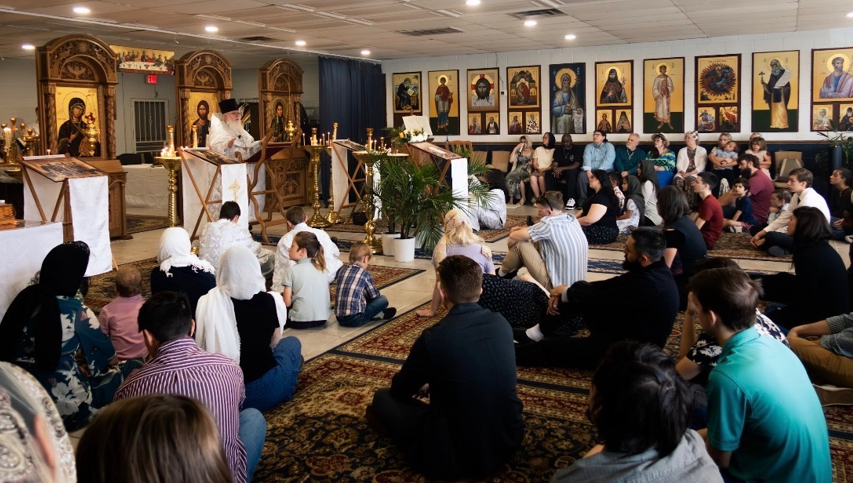
If you are wondering what to expect at Orthodox liturgy, the first thing to know is that you are not walking into a performance or a lecture. You are entering the worship of the Church – reverent, ordered, scriptural, and offered to God. For many visitors, especially those coming from evangelical or Roman Catholic backgrounds, the experience can feel both unfamiliar and deeply recognizably Christian.
That first impression matters. The icons, the chanting, the incense, the movement, and the repeated prayers are not decorative additions to worship. They are part of how Orthodox Christians pray with the whole person – body, mind, and soul. A newcomer does not need to master everything at once. You do not need to know when to cross yourself, when to bow, or how to follow every hymn in order to attend fruitfully.
What to expect at Orthodox liturgy when you first arrive
Most Orthodox parishes begin with a quieter atmosphere than many modern churches. People often enter prayerfully, light candles, venerate icons, and prepare for worship before the main service is fully underway. That can surprise visitors who are used to a social, conversational entry into church. The quiet is not coldness. It is preparation.
You may also notice that people arrive at different times. In many parishes, matins or orthros is served before the Divine Liturgy, and some faithful come early for those prayers. Others arrive closer to the beginning of the liturgy itself. If you are visiting for the first time, arriving a little early is wise. It gives you time to settle in without feeling rushed and to ask a simple question if needed.
Dress is generally modest and respectful. Men typically wear long pants and a collared shirt or something similarly neat. Women usually dress modestly as well. In some Orthodox settings women cover their heads, but practices vary by parish, and a visitor should not feel anxious about getting every custom right on the first visit. Reverence matters more than trying to imitate everyone around you.
The service may feel full – because it is
Orthodox liturgy is not built around a short sequence of songs, announcements, sermon, and dismissal. It is fuller and more continuous. There are litanies, psalms, hymns, processions, Scripture readings, prayers for the world, and the Eucharist. Much of it is sung or chanted.
For some visitors, that fullness is refreshing. For others, it can feel dense at first. Both reactions are understandable. The Orthodox Church does not reduce worship to what is instantly accessible. It hands down a received form of prayer that has shaped Christians for centuries. That means the liturgy asks something of you – attention, patience, and humility.
You may stand more than you expect. In Orthodox worship, standing is a sign of reverence and readiness before God. That said, there is pastoral room here. Elderly worshipers, parents managing small children, and those with physical limitations may sit when needed. No serious parish should expect a visitor to suffer in order to appear devout.
Why there is so much chanting, incense, and movement
A first-time visitor often asks whether these things are symbolic. The answer is yes, but not merely symbolic. Orthodox worship assumes that God sanctifies matter and that human beings worship with the body as well as the mind.
Chanting gives prayer a steadiness and gravity that ordinary speech does not. Incense reflects biblical worship and honors the holiness of what is taking place. Processions, bows, and the sign of the cross are not religious theatrics. They are acts of participation. The liturgy is not there to entertain the congregation. It is there to form the congregation.
This is one reason children are present in Orthodox worship rather than sent away from it as though the main service were only for adults. Children may not understand every word, but they are learning how the Church prays. Families often appreciate this once they realize that worship is not supposed to be frictionless. It is supposed to shape us over time.
What to expect at Orthodox liturgy during the Eucharist
The high point of the Divine Liturgy is Holy Communion. Orthodox Christians believe the Eucharist is truly the Body and Blood of Christ, not a mere reminder. Because of that, communion is given with reverence and within the life of the Church.
Visitors who are not Orthodox should expect not to receive communion. This can be difficult for some, especially if they come from traditions where open communion is standard. But the Orthodox practice is not meant as a personal insult or social exclusion. It reflects a serious conviction that communion expresses full unity of faith, sacramental life, and ecclesial membership. Sharing the chalice is not the first step toward unity. It is one of its fruits.
That distinction matters. Many visitors are relieved when someone explains it plainly. You are still welcome to attend, to pray, and to speak with the priest afterward. In many parishes, non-Orthodox visitors may come forward at the end for blessed bread if that local custom is observed, though practices vary and a visitor may simply remain in place if unsure.
The sermon may be shorter than you expect
In some Protestant settings, the sermon is the central event. In Orthodox worship, the sermon matters, but it is not the center. The liturgy itself is the central act of worship, culminating in the Eucharist.
This often helps visitors recalibrate their expectations. If you are used to evaluating a church mainly by preaching style, music quality, or program offerings, Orthodox worship may challenge that habit. The question shifts from “Did I enjoy this?” to “Was God rightly worshiped, and was I taught to join that worship faithfully?”
That does not mean the sermon is unimportant. Faithful Orthodox preaching should be biblical, doctrinally clear, and connected to repentance and holy living. But it is delivered within a larger sacramental life, not as a replacement for it.
Practical guidance for first-time visitors
If you do not know when to stand, sit, bow, or cross yourself, you are not alone. Most parishes understand this. It is perfectly acceptable to observe quietly. Following along as best you can is enough for a first visit.
You do not need to venerate icons if you are not ready. You do not need to force yourself into customs you do not yet understand. At the same time, come willing to learn rather than holding the Church at arm’s length. Orthodoxy is best understood from within its worship, not by judging it according to modern assumptions about convenience or relevance.
If you have children, bring them. Orthodox parishes expect children to be present, and normal child noise is not a scandal. Parents should guide their children toward reverence, of course, but a parish that welcomes families should understand the difference between formation and unrealistic perfection.
If possible, stay a few minutes afterward and speak with the priest or a knowledgeable parishioner. The best first question is often a simple one: “I am new. Can you help me understand what I experienced today?” Serious parishes are glad to answer that question.
Why the unfamiliarity can be a gift
For many people, especially those who have grown tired of casual Christianity, the first Orthodox liturgy is disorienting in a good way. It does not flatter modern preferences. It does not market itself. It does not ask whether worship can be made more efficient, more trendy, or more emotionally immediate.
Instead, it presents something older and steadier. That can be uncomfortable, especially at first. Yet discomfort is not always a sign that something is wrong. Sometimes it is a sign that you are encountering a form of Christian worship not built around your habits.
For inquirers in places like Surprise, Peoria, Glendale, Buckeye, Litchfield Park, and Waddell, that encounter may become the beginning of something deeper than a church visit. It may become the first step toward a life ordered by prayer, repentance, sacramental grace, and the mind of the historic Church. If you come with humility, attention, and patience, you may find that what first seemed unfamiliar begins to feel like home.