The celebration and participation at these memorial services is very much a part of the Orthodox spiritual tradition, and very valuable for spiritual formation. Praying for the departed is an important work of mercy in our spiritual tradition, and should not be forgotten, taken lightly, or ignored!
What is a Panikhida?
The Panikhida is a solemn memorial prayer service in the Orthodox Church for the repose of the souls of the departed. During the service, the faithful pray for God to forgive the sins of the deceased and grant them eternal rest in His heavenly kingdom.
The word ‘panikhida’ is from Slavonic: панихида, panikhída, from Greek παννυχίς, pannychis, “vigil” (etymologically meaning “all-nighter”) pronounced pan-ih-KHEE-da.
Service Details
The service is led by a priest and consists of Psalms, litanies (ektenias), hymns, and prayers. A key part of the service is the final, slow and solemn singing of “Memory Eternal”.
Koliva
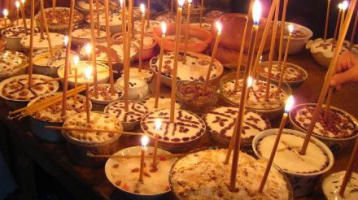 A traditional element often brought by family and friends for the service is koliva, a dish made of boiled kernels of wheat mixed with dried fruit and nuts, which is then blessed and eaten at the end of the memorial. The wheat symbolizes the resurrection, based on the biblical principle that a grain must fall to the earth and die before it can bear fruit.
“Truly, truly, I say to you, unless a grain of wheat falls into the earth and dies, it remains alone; but if it dies, it bears much fruit.” – John 12:24.
The Panikhida is known by other names in different Orthodox traditions, such as Parastas or Pannychis in the Greek Orthodox Church. The service is generally only performed for the souls of those who were Orthodox Christians.
A Work of Mercy
The Panikhida is an act of love and mercy that brings spiritual benefit to the departed and consolation to the living.
Services are held on various occasions:
- Immediately after death (the “First Panikhida”), often at the location where the person passed away.
- Specific days following death: Traditionally on the third, ninth, and fortieth day after the repose.
- Anniversaries: Annually on the anniversary of the death, or other significant dates such as the birthday or wedding anniversary of the departed.
- Church-appointed days: On special “Parental Saturdays” throughout the year, which are dedicated to the commemoration of all the faithful departed.
- As requested: Families can request a Panikhida at any other appropriate time.
- Saturday is generally a day dedicated to prayer for the departed, because Christ lay dead in the Tomb on a Saturday. In some monasteries and large churches, it is customary to serve a Panikhida on every Saturday, unless a major feast occurs on that day.