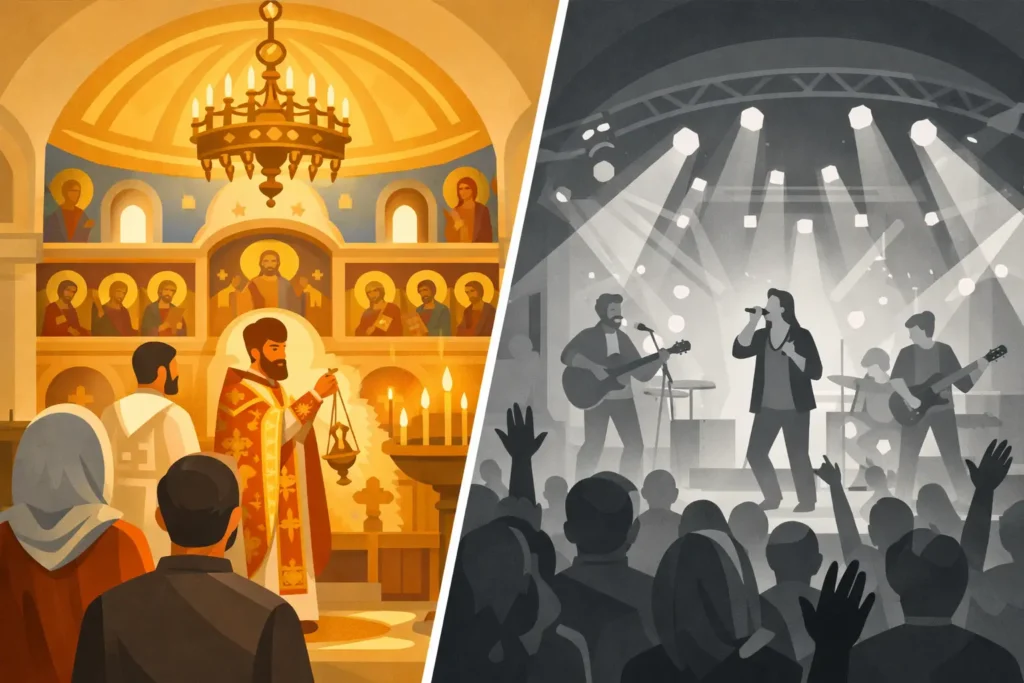
A divine liturgy vs worship service comparison is not mainly about old prayers versus new music, formal clothing versus casual clothing, or incense versus a stage. The deeper question is this: What does the Church believe happens when Christians gather before God? Orthodox Christians do not come to the Divine Liturgy chiefly to attend a religious program. We come to offer worship to the Holy Trinity, to receive the life of Christ, and to be joined to the worship already taking place in heaven.
For many Christians exploring Orthodoxy, the first visit can feel both beautiful and unfamiliar. The service has a definite shape. Much is sung. People stand, make the sign of the cross, venerate icons, hear Scripture, pray for the whole world, and receive Holy Communion. These actions are not decorative extras. They express what the Church believes about God, salvation, the human person, and the Kingdom.
Divine Liturgy vs Worship Service: The Central Difference
Many Christian communities use the phrase “worship service” for their Sunday gathering. That phrase can cover a wide range of practices, from a simple meeting centered on Scripture and preaching to a highly produced service shaped by music, announcements, and a sermon. Orthodox Christians also worship when we gather, of course. But the name Divine Liturgy says something more precise.
“Liturgy” means a public work undertaken by the people. In the Church, it is the work of God and His people together. Christ is not absent while we remember Him from a distance. He is the true celebrant, the High Priest who offers and is offered. The bishop or priest serves visibly at the altar, but Christ Himself gathers His people, receives their offering, and feeds them with His Body and Blood.
This is why the Divine Liturgy cannot be reduced to a worship style. It is sacramental participation in the saving work of Christ. The Church does not repeat Calvary, as though Christ must die again. Rather, the one sacrifice of Christ is made present to us sacramentally. We enter the reality of His death, resurrection, ascension, and coming Kingdom.
Worship Is Offered, Not Consumed
A modern worship service can easily be evaluated like a product: Was the music moving? Was the message practical? Did the atmosphere fit my preferences? Every church should strive to preach faithfully and receive visitors with love. Yet Orthodox worship asks a prior question: Did we give God the worship He has taught His Church to offer?
The Divine Liturgy turns us away from self-expression as the center of worship. We bring our repentance, our needs, our gratitude, our suffering, and our intercessions. But we do not gather to create an emotional experience. We gather to stand before the living God.
That does not make the Liturgy cold or impersonal. In fact, it gives emotion its proper place. Joy, sorrow, awe, grief, gratitude, and holy fear all belong there. The difference is that our feelings do not govern the worship. The Church’s prayer forms us, including on days when our feelings are weak, distracted, or burdened.
A service built primarily around immediate accessibility may feel easier on a first visit. The trade-off is that it can become dependent on personalities, trends, and constantly changing preferences. The Divine Liturgy asks more patience from a newcomer, but it offers something stable: worship received from the Church rather than invented anew by each generation.
The Liturgy Is Rooted in Scripture
Visitors sometimes assume Orthodox worship is less biblical because it does not resemble the church services they know. In reality, the Divine Liturgy is more biblical, saturated with Scripture Psalms shape its prayers. The Gospels are proclaimed aloud. Its hymns confess biblical events and images. Its language echoes the prophets, the apostles, and the book of Revelation.
When the priest blesses the people, when the congregation sings “Holy, Holy, Holy,” when we pray for rulers and those in need, when we hear the Gospel, and when we approach the chalice, we are not leaving Scripture behind. We are inhabiting it.
The Liturgy also protects the Church from treating the Bible as a collection of isolated verses. Scripture is heard within the worshiping community that received, preserved, proclaimed, and interpreted it. The readings do not simply support a sermon topic. They place us before Christ, who speaks to His people through His Word.
The Eucharist Changes the Shape of the Gathering
The greatest practical difference between the Divine Liturgy and many worship services is the Eucharist. In Orthodox Christianity, Holy Communion is not an occasional add-on to the main event. It is the fulfillment toward which the entire Liturgy moves.
The Church hears the Word because Christ speaks. The Church prays because Christ intercedes. The Church offers bread and wine because Christ offers Himself. The Church receives Communion because Christ gives His true Body and Blood for the life of the world.
This conviction explains why Orthodox Christians prepare seriously for Communion. We fast as directed, pray, examine our consciences, seek forgiveness, and confess serious sins. Preparation is not a way to earn grace. No one earns the gift of God. It is a way of approaching the holy things with repentance, faith, and reverence.
It also explains why Communion is ordinarily received by baptized or chrismated Orthodox Christians who are prepared and at peace with the Church. This can surprise guests from traditions that practice open communion. The boundary is not intended as rejection. It is an honest confession that Communion expresses a real unity of faith, baptism, sacramental life, and submission to the Church. Visitors are welcomed with warmth, invited to receive blessed bread when it is offered, and encouraged to speak with the priest about the path into the Church.
Beauty Serves Truth
Icons, vestments, candles, chanting, processions, and incense can seem foreign to someone formed by a plain worship environment. Yet Orthodox worship does not use beauty to distract from Christ. Beauty serves truth because the Incarnation makes matter capable of bearing divine grace. The eternal Son truly took flesh. He sanctified the material world without confusing creation with the Creator.
An icon is not a god, nor is it a religious decoration. It bears witness that the Word became visible in Jesus Christ and that His saints have been transformed by His grace. Incense reflects the prayers of the saints rising before God. Candles confess that Christ is the Light of the world. Bodily actions remind us that we do not worship as disembodied minds. We bow, stand, sing, and receive because God saves whole persons.
None of this means every Orthodox parish will feel identical. Languages, local customs, musical settings, and pastoral circumstances can vary. But the core of the Divine Liturgy is not an experiment in preference. It is the Church’s received worship.
What Should a First-Time Visitor Do?
Do not worry about getting every movement right. Stand where you are able, follow the service book if one is available, and allow yourself time to listen. You are not expected to know when to cross yourself, bow, or sing every response on your first visit.
If you are not Orthodox, do not receive Holy Communion, but do not mistake that instruction for distance. Speak with the priest or a parishioner after the service. Ask direct questions. A serious Orthodox parish should be glad to explain what you saw, why the Church worships this way, and how catechism prepares adults and families for a life of faith rather than a momentary religious decision.
At All Saints of North America Orthodox Church, seekers from Surprise, Peoria, Glendale, Sun City, and the wider west Phoenix area can find not only a place to visit, but a deliberate path for learning the Orthodox faith. The goal is not to pressure anyone into a quick answer. It is to lead people patiently toward repentance, baptism, communion, and a transformed life in Christ.
The Divine Liturgy may not give you everything you expect from a worship service. It gives something better: an invitation to set aside expectation, stand before the King of Glory, and let the Church teach your heart how to worship.