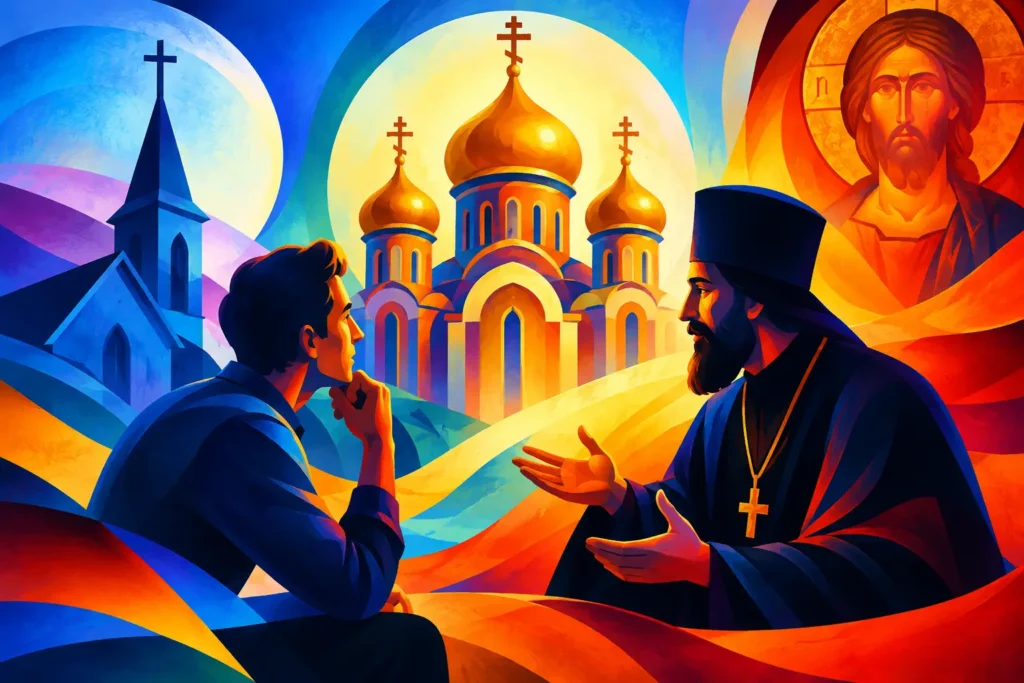
A Protestant friend may ask, “Why would you need tradition when you have the Bible?” Or, after seeing an Orthodox service, “Why all the icons, chanting, and repetition?” To explain Orthodoxy to Protestants well, begin by recognizing that these are usually sincere questions. Many Protestants love Christ, read Scripture earnestly, and want to obey God. The goal is not to win a religious argument. It is to show the coherence, beauty, and apostolic fullness of the Orthodox faith.
Explain Orthodoxy to Protestants as the Apostolic Church
The simplest place to begin is this: Orthodoxy is not a new denomination, a Greek ethnic custom, or a “Catholicism without the Pope.” The Orthodox Church understands herself to be the Church founded by Jesus Christ, preached by the apostles, guarded by the martyrs, and confessed by the saints through the centuries.
That claim deserves a patient explanation. Protestants often come from communities that trace their roots to the Reformation, revival movements, or more recent independent churches. Orthodox Christianity asks a different historical question: What did the Church believe, pray, and practice before the divisions of later centuries?
The answer is not that every Orthodox Christian has always behaved faithfully. Church history includes sin, betrayal, political pressure, and human weakness. Christ did not promise that every bishop or parishioner would be holy. He promised that the gates of Hades would not prevail against His Church. Orthodoxy rests its confidence there: in Christ’s faithfulness to the Body He established.
This also explains why Orthodox Christians care so deeply about continuity. Apostolic succession is not merely a chain of names. It is the Church’s living continuity in faith, worship, sacramental life, and pastoral authority. A bishop receives not a private religious platform, but a responsibility to preserve what he has received.
Scripture and Tradition Belong Together
For many Protestants, the central concern is authority. They may fear that Orthodox Tradition adds human ideas to God’s Word. The Orthodox answer is that Holy Tradition is not a second source of revelation competing with Scripture. It is the life of the Holy Spirit in the Church, of which Scripture is the preeminent written witness.
The Bible came from within the worshiping Church. The apostles preached before the New Testament was gathered into a single canon. The Church recognized which writings were apostolic and read them in her worship. Scripture therefore does not stand against the Church as though Christians must choose one or the other. The Church receives, proclaims, interprets, and obeys Scripture.
A helpful way to say this is: Orthodox Christians do not believe in “Bible plus traditions.” We believe in the apostolic faith, handed down in Scripture, worship, councils, creeds, and the lives of the saints. Paul himself tells believers to hold fast to the traditions they received, whether by spoken word or letter.
This does not give Orthodox Christians permission to invent doctrines. Tradition is tested by its fidelity to the apostolic faith. The Church cannot reverse the Gospel, redefine Christ, or bless what God calls sin. Tradition is a safeguard against novelty, not a license for it.
Salvation Is More Than a Legal Declaration
Protestants often speak of salvation in terms of forgiveness, faith, grace, and assurance. Orthodoxy gladly confesses that we are saved by God’s grace, that Christ alone conquers sin and death, and that no one earns salvation by moral achievement. Yet Orthodoxy commonly uses a wider biblical vision: salvation is healing, union with God, resurrection, and transformation.
Sin is not only guilt before a Judge, though it truly involves guilt. It is also a wound, a corruption, and a slavery from which Christ rescues us. The Son of God became man, entered death, and rose again so that human beings might share His life. Orthodox Christians call this theosis: becoming by grace what God is by nature, or participating in the divine life without ever becoming God by nature.
This can sound unfamiliar to an evangelical ear, but it is not a denial of justification by faith. Faith is living trust and union with Christ, not bare agreement with facts. Saving faith bears fruit in repentance, obedience, prayer, mercy, and perseverance because Christ is actually at work in the person who believes.
The difference matters pastorally. The Christian life is not only about securing a verdict for heaven. It is about being remade into the likeness of Christ. We do not obey in order to purchase God’s love. We obey because His grace calls us out of death and into communion with Him.
Why Sacraments Matter
Orthodox Christians baptize, chrismate, confess, receive the Eucharist, marry, and anoint the sick because God uses material things to communicate His grace. This should not surprise Christians who confess the Incarnation. The eternal Word took real flesh. He used water, touch, bread, wine, mud, and spoken words in His ministry.
Baptism is not merely a public symbol of an inward decision. It is participation in Christ’s death and resurrection. Chrismation is the gift and seal of the Holy Spirit. In the Eucharist, the Church receives true communion in the Body and Blood of Christ. Orthodox Christians do not reduce this mystery to a mental reminder, but neither do we pretend to explain it mechanically. We receive it with reverence because Christ said, “This is My Body.”
A Protestant may worry that sacramental language makes grace automatic. It does not. God is not a machine, and the sacraments are not religious magic. They call for faith, repentance, and a life turned toward Christ. Yet they are real gifts, not empty religious illustrations.
Saints, Mary, and Icons Are About Christ
These subjects often carry the most emotional weight, especially for those formed in traditions that warn against idolatry. Address them directly and without defensiveness.
Orthodox Christians worship God alone: Father, Son, and Holy Spirit. We honor the saints because they are alive in Christ, not because they replace Him. Asking a saint to pray is no more a rival to Christ’s mediation than asking a faithful friend at church to pray for you. Christ is the one Mediator who reconciles humanity to the Father. The saints intercede only because they belong to Him.
The Virgin Mary receives special honor because she is the Mother of God, meaning the One she bore is truly God incarnate. Calling her Theotokos protects the truth about Jesus. It does not make Mary a fourth person of the Trinity or a goddess.
Icons are not idols. An idol is a false god. An icon is an image that points beyond itself to the person depicted. Christians honor photographs of loved ones without confusing paper and ink for the person. More profoundly, icons confess that the invisible God truly became visible in Jesus Christ. Because the Word became flesh, matter can bear witness to Him.
Worship Forms Us Before We Can Explain Everything
A visitor from a low-church Protestant background may find Orthodox worship intense: standing, incense, sung prayers, Scripture woven through every service, and little concern for keeping things brief. Do not apologize for the Church’s worship, but do help people enter it.
The Divine Liturgy is not religious entertainment or a lecture with music added. It is the gathered Church offering praise to God and receiving His gifts. The worship is deliberately repetitive because human beings need to pray the truth repeatedly. We repeat the Psalms, the Lord’s Prayer, and the words of Scripture not because we lack imagination, but because the faith must sink beneath our changing moods.
At the same time, be honest about the adjustment. Orthodox worship can feel unfamiliar, and newcomers may not understand every action on a first visit. They do not need to perform expertise. They can stand where they are comfortable, listen, pray, and let the service teach them over time.
Explain Orthodoxy With Patience, Not Pressure
The most convincing explanation is a truthful life. If we speak about holy Tradition while acting proud, harsh, or careless with our neighbor, we obscure the faith we claim to defend. Protestants should encounter in Orthodox Christians both doctrinal clarity and genuine humility.
Ask questions before giving answers. What does your friend mean by “saved”? What have they heard about icons? What do they fear they may lose if they become Orthodox? Some need to hear the Church’s historical claim. Others need careful teaching about confession, baptism, or the Eucharist. A person wounded by manipulative religion may first need to see that authority in the Church exists for healing, not control.
Do not promise that Orthodoxy makes the Christian life easy. It calls us to repentance, fasting, forgiveness, sacrificial love, and steady participation in the life of the Church. But it also gives what modern religious individualism cannot: a home in the communion of saints, a stable rule of prayer, and a life ordered around Christ.
If you live in the west Phoenix area and are asking these questions, come as an inquirer, not as a spectator required to have every answer. At All Saints of North America Orthodox Church, serious catechesis gives seekers room to ask hard questions and to meet the faith as a whole. Christ does not call us to invent a Christianity for ourselves. He calls us into His Church, where repentance becomes a way of life and where, by His mercy, we learn to become saints.