Clothed in Christ: The Theology of Orthodox Vestments
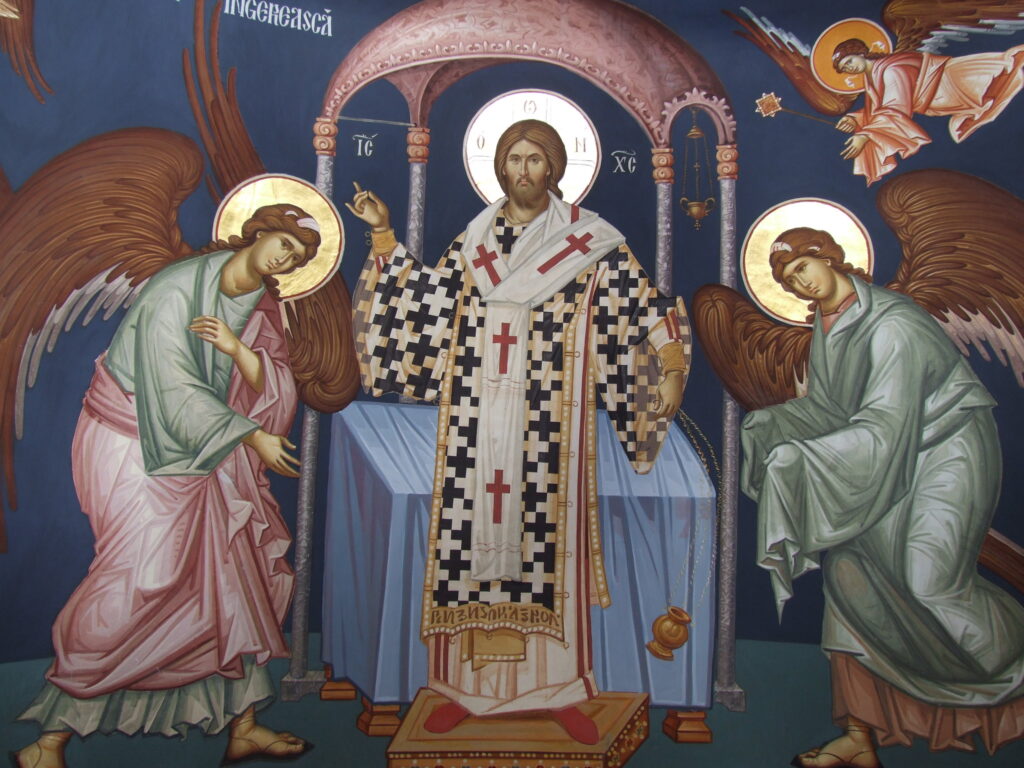
In the Russian Orthodox Church, vestments are far more than ceremonial garments. They are visible signs of the grace of Holy Orders and the sacred ministry entrusted to those who serve in the Church. Every vestment has a practical purpose, a theological meaning, and a prayer that accompanies its being put on. These prayers remind the clergy and servers that they are not acting in their own strength but are clothed in Christ Himself.
The vesting prayers draw heavily from the Psalms, Isaiah, and other biblical texts, emphasizing purity, righteousness, salvation, and joyful service before God.
This article follows the traditional order of service in the Russian Orthodox Church, beginning with altar servers and readers, then subdeacons, deacons, and finally priests.
Altar Server
 Vestment
Sticharion (Стихарь)
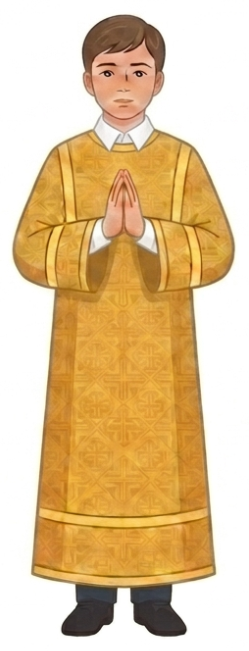
The sticharion is a long, flowing robe with wide sleeves. It is the foundational liturgical garment and is worn by altar servers, readers (when blessed), subdeacons, deacons, and bishops. Although similar in appearance across the ranks, its style varies. Servers generally wear a simple, brightly colored sticharion.
Symbolism
The sticharion represents:
- The garment of salvation
- Purity of heart
- The white robe of baptism
- The radiant clothing of the angels
- The new life received in Christ
It reminds the server that everyone who ministers in the altar should strive for purity and holiness.
Vesting Prayer
Traditionally, altar servers recite the prayer for the sticharion from Isaiah 61:10;
Sticharion Prayer
My soul shall rejoice in the Lord, for He has clothed me with the garment of salvation; He has covered me with the robe of gladness; as a bridegroom He has set a crown on me, and as a bride adorns herself with jewels, so He has adorned me.
Isaiah 61:10
Meaning
The altar server is clothed not merely in fabric but in the joy of salvation.
Reader
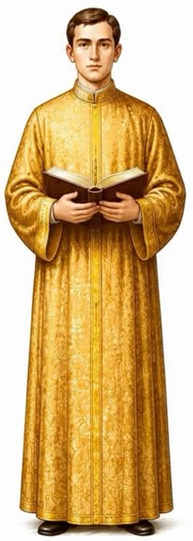
Readers generally wear the same sticharion when blessed to read during the Divine Liturgy.
Meaning of the Reader’s Ministry
The reader proclaims the inspired Scriptures to the faithful and preserves the apostolic teaching through public reading. His sticharion reminds him that he must first live the Word before proclaiming it.
As with altar servers, the sticharion prayer is prayed when vesting.
Sticharion Prayer
My soul shall rejoice in the Lord, for He has clothed me with the garment of salvation; He has covered me with the robe of gladness; as a bridegroom He has set a crown on me, and as a bride adorns herself with jewels, so He has adorned me.
Isaiah 61:10
Meaning
The Reader is clothed not merely in fabric but in the joy of salvation, same as for the Altar Server.
 Subdeacon
Vestments
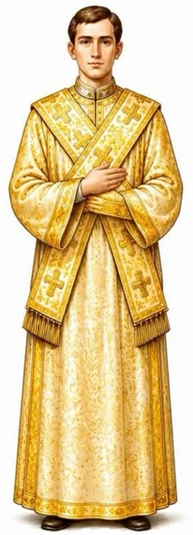
- Sticharion
- Orarion, crossed front and back
The subdeacon’s crossed orarion distinguishes him from the deacon. It symbolizes his readiness to assist the bishop and clergy while remaining in a ministry of service rather than proclamation.
Sticharion Prayer
My soul shall rejoice in the Lord, for He has clothed me with the garment of salvation; He has covered me with the robe of gladness; as a bridegroom He has set a crown on me, and as a bride adorns herself with jewels, so He has adorned me.
Isaiah 61:10
Meaning
The subdeacon is clothed not merely in fabric, but in the joy of salvation.
Orarion (Subdeacon’s stole)
Prayer
Generally, there is no prayer when vesting with the orarion for a subdeacon. The subdeacon simple kisses the central cross on the orarion before vesting with it.
Meaning
The orarion wrapped around the subdeacon signifies:
- Spiritual readiness
- Strength for service
- Self-control
- Discipline
Just as Christ girded Himself to wash the disciples’ feet, the subdeacon girds himself for humble service.
 Deacon
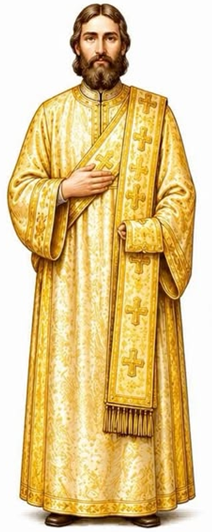
The deacon wears four principal vestments:
- Sticharion
- Epimanikia (cuffs)
- Orarion
- Kamilavka (an honorific – that is, an award for service)
Sticharion
Prayer
My soul shall rejoice in the Lord, for He has clothed me with the garment of salvation; He has covered me with the robe of gladness; as a bridegroom He has set a crown on me, and as a bride adorns herself with jewels, so He has adorned me.
Isaiah 61:10
Meaning
The deacon becomes an icon of the angels who continually minister before God’s throne.
Epimanikia (Cuffs)
Right Cuff Prayer
Thy right hand, O Lord, is become glorious in strength; Thy right hand, O Lord, hath dashed in pieces the enemy; and in the multitude of Thy glory Thou hast overthrown Thine adversaries.
Exodus 15:6–7
Left Cuff Prayer
Thy hands have made me and fashioned me; give me understanding, and I shall learn Thy commandments.
Psalm 118 [119]:73
Meaning
The cuffs remind the deacon:
- His strength comes from God.
- His ministry is performed by God’s hands rather than his own.
- Every liturgical action is sanctified.
Orarion
The orarion is the distinctive vestment of the deacon. It is a long band worn over the left shoulder. During the litanies the deacon raises its end as he petitions the Lord.
Symbolism
The orarion signifies:
- Angelic wings
- Readiness for ministry
- The grace of Holy Orders
- Proclamation of the Gospel
- Prayer ascending before God
Unlike the priest’s stole, the deacon’s orarion signifies service rather than pastoral authority.
There is no separate vesting prayer for the orarion in the service books. The deacon simply kisses the orarion on the central cross, and vests with it.
 Priest
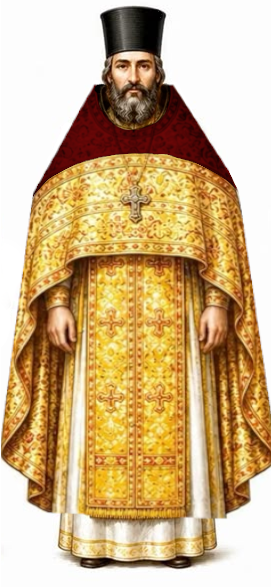
The priest wears six principal vestments:
- Sticharion
- Epitrachelion
- Zone
- Epimanikia
- Epigonation (when awarded)
- Phelonion
Sticharion
Unlike the deacon’s full robe, the priest’s sticharion (podriznik) is usually white with narrower sleeves.
Prayer
My soul shall rejoice in the Lord, for He has clothed me with the garment of salvation; He has covered me with the robe of gladness; as a bridegroom He has set a crown on me, and as a bride adorns herself with jewels, so He has adorned me.
Isaiah 61:10
The meaning remains identical: the joy of salvation, purity, and divine grace.
Epitrachelion (Stole)
The epitrachelion is the essential priestly vestment. Without it, no sacrament may be celebrated.
Prayer
Blessed is God Who poureth out His grace upon His priests; as myrrh upon the head that runneth down upon the beard, the beard of Aaron, that runneth down to the border of his garment.
Psalm 132 [133]
Meaning
The epitrachelion represents:
- Priestly grace
- Apostolic succession
- The yoke of Christ
- Authority to celebrate the Mysteries
Zone (Belt)
Prayer
Blessed is God Who girdeth me with strength and maketh my way blameless. He made my feet like hind’s feet, and set me secure on the heights.
Psalm 18:32-33
Meaning
The priest is strengthened for sacrificial ministry and prepared to stand before the Holy Table.
Epimanikia
The same prayers are used as by the deacon.
They remind the priest that every sacramental act is God’s work rather than his own.
Epigonation (Nabedrennik/Palitza)
Awarded to certain priests as an ecclesiastical distinction/award.
Prayer
Gird Thy sword upon Thy thigh, O Mighty One, in Thy comeliness and beauty. Go forth, prosper, and reign because of truth, meekness, and righteousness, and Thy right hand shall guide Thee wondrously always, now and ever, and unto ages of ages. Amen.
Psalm 44 [45]:3–5
Meaning
The epigonation symbolizes:
- The sword of the Spirit
- Defense of the Orthodox Faith
- Excellence in preaching
- Readiness for spiritual warfare
Phelonion
The phelonion is the priest’s outer vestment. It envelops nearly the entire body and symbolizes Christ’s righteousness covering the priest. In the Russian tradition, it is a high backed vestment with a stiff yoke.
Prayer
Thy priests, O Lord, shall clothe themselves with righteousness, and Thy saints shall rejoice with joy always, now and ever, and unto ages of ages. Amen.
Psalm 131 [132]:9
Meaning
The phelonion reminds the priest:
- He ministers clothed in Christ.
- His righteousness is received from God rather than earned.
- He represents Christ the High Priest before the people.
- He has taken upon himself the ‘yoke’ of Christ, bearing the burdens of his people.
Bishop
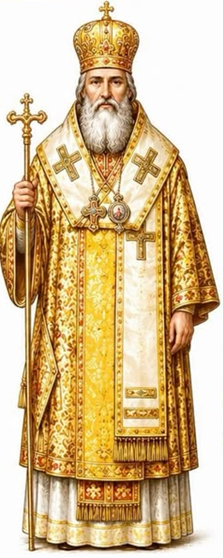 The bishop eight eight principal vestments:
- Sticharion
- Epitrachelion
- Zone
- Epimanika
- Paltiza (Epigonation)
- Sakkos
- Omophorion
- Miter
- Pastoral Staff
Sticharion
Unlike the deacon’s full robe, the bishop’s sticharion (podriznik), like the priest’s, is usually white with narrower sleeves.
Prayer
My soul shall rejoice in the Lord, for He has clothed me with the garment of salvation; He has covered me with the robe of gladness; as a bridegroom He has set a crown on me, and as a bride adorns herself with jewels, so He has adorned me.
Isaiah 61:10
The meaning remains identical: the joy of salvation, purity, and divine grace.
Epitrachelion (Stole)
The epitrachelion is the essential priestly vestment. Without it, no sacrament may be celebrated. A bishop is still a priest, so he still wears it.
Prayer
Blessed is God Who poureth out His grace upon His priests; as myrrh upon the head that runneth down upon the beard, the beard of Aaron, that runneth down to the border of his garment.
Psalm 132 [133]
Meaning
The epitrachelion represents:
- Priestly grace
- Apostolic succession
- The yoke of Christ
- Authority to celebrate the Mysteries
Zone (Belt)
Prayer
Blessed is God Who girdeth me with strength and maketh my way blameless. He made my feet like hind’s feet, and set me secure on the heights.
Psalm 18:32-33
Meaning
The priest is strengthened for sacrificial ministry and prepared to stand before the Holy Table.
Epimanika (Cuffs)
The same prayers are used as by the deacon.
They remind the bishop that every sacramental act is God’s work rather than his own.
Palitza
Worn by all Bishops.
Prayer
Gird Thy sword upon Thy thigh, O Mighty One, in Thy comeliness and beauty. Go forth, prosper, and reign because of truth, meekness, and righteousness, and Thy right hand shall guide Thee wondrously always, now and ever, and unto ages of ages. Amen.
Psalm 44 [45]:3–5
Meaning
The Palitza symbolizes:
- The sword of the Spirit
- Defense of the Orthodox Faith
- Excellence in preaching
- Readiness for spiritual warfare
The Sakkos (Episcopal Tunic)
The Vesting Prayer
“Thy high priests, O Lord, shall be clothed with righteousness, and Thy holy ones shall rejoice with joy. Always, now and ever, and unto ages of ages. Amen.”
The Theological & Historical Meaning
- The Mocking of Christ: Spiritually, the sakkos represents the scarlet or purple robe placed on Jesus Christ by the Roman soldiers to mock Him during His Passion. It serves as a reminder of Christ’s humility and the bishop’s duty to imitate that humility.
- Imperial Origin: Historically, the sakkos was a Byzantine imperial garment worn by the emperor. After the fall of Constantinople in 1453, the Patriarchs (and eventually all bishops) adopted the imperial dress to reflect their role as spiritual leaders and guardians of the Christian flock.
- The Bells: The bells fastened to the sides represent the proclamation of the Word of God and echo the vestments of the High Priest Aaron in the Old Testament.
The Omophorion (The Bishop’s Stole)
The Vesting Prayer
“When Thou didst take upon Thy shoulders human nature which had gone astray, O Christ, Thou didst bear it to heaven unto Thy God and Father. Always, now and ever, and unto ages of ages. Amen.”
The Theological & Historical Meaning
- The Lost Sheep: The omophorion is historically made of wool to symbolize the lost sheep. Draped over the bishop’s shoulders, it signifies how Christ the Good Shepherd finds lost humanity, places it upon His shoulders, and carries it back to the Father.
- The Bishop as Good Shepherd: It visually defines the bishop’s primary mission: to act as the living icon of Christ, actively seeking out, guarding, and carrying the spiritual burdens of his flock.
- The Crosses: The prominent crosses on the band demonstrate the bishop’s readiness to bear his own cross and suffer for the sake of his community.
The Two Forms
- Great Omophorion: A long, loose scarf wrapped around the neck, with one end hanging down the front to the knees and the other down the back. It is worn during the initial, solemn parts of the Divine Liturgy.
- Small Omophorion: A shorter, simplified version that resembles a priest’s epitrachelion but is wider. It hangs straight down the center chest and is substituted after the Gospel reading to give the bishop greater freedom of movement during the Eucharistic prayers.
The Mitre (Episcopal Crown)
“The Lord set upon thy head a crown of precious stones, and thou askedst life of Him, and He gave thee length of days. Always, now and ever, and unto ages of ages. Amen.”
Theological & Historical Meaning
- The Crown of Thorns and the Crown of Glory: Paradoxically, the mitre carries a dual spiritual meaning. It symbolizes the crown of thorns placed on the head of Jesus Christ during His Passion, reminding the bishop of the suffering and humility required of his office. At the same time, it represents the triumphant crown of glory promised to the faithful in the Kingdom of Heaven.
- The Crown of the High Priest: The prayer references the Old Testament vestments of Aaron and the Levitical high priests. The mitre signifies that the bishop is the head of the local eucharistic assembly, acting in the image of Christ, the Ultimate High Priest.
- Imperial Adoption: Like the sakkos, the crown-style mitre was originally a piece of Byzantine imperial regalia worn by the emperors. After the fall of Constantinople in 1453, Eastern Christian bishops adopted it into their liturgical dress to represent their spiritual guardianship over the Christian people.
- The Four Icons: Traditional mitres feature four small icons around the base—usually depicting Jesus Christ, the Mother of God (Theotokos), John the Baptist, and the patron saint of the church or diocese. A fifth icon or a cross traditionally sits at the very top of the dome.
The Pastoral Staff
The Vesting Prayer
“The Lord will send thee a rod of power out of Zion, and thou shalt rule in the midst of Thine enemies.” (Psalm 110:2)
The Theological & Historical Meaning
- The Shepherd’s Crook: Spiritually, the staff represents the shepherd’s rod. Just as a physical shepherd uses a staff to guide, gather, and protect sheep, the bishop uses the pastoral staff to guide his spiritual flock toward salvation and defend them from spiritual dangers.
- The Rod of Moses: The staff also links back to the Old Testament, representing the miraculous rod of Moses and Aaron, which brought forth water in the desert and symbolized God’s chosen authority and leadership.
Anatomy and Design
The Double Serpent Cross: The top of the staff is typically shaped like a cross flanked by two intertwined serpents facing each other. This specific design holds a dual meaning:
- Wisdom and Healing: It references Christ’s command to be “wise as serpents” (Matthew 10:16) and the bronze serpent raised by Moses in the wilderness, which healed the Israelites (Numbers 21:9)—a prophecy of Christ on the Cross.
- Spiritual Warfare: The serpents bowing before the cross symbolize the bishop’s authority to trample upon the spiritual enemy and guard the faith against heresy.
The Mantle Cloth (Sudarium)
In the Slavic tradition, a beautifully embroidered cloth called a sudarium or sulok is often tied to the top bar of the staff. This historically protected the bishop’s hand from freezing during cold outdoor processions, but it now represents the veil of mysteries and the dignity of the office.
Vestments as an Icon of the Heavenly Kingdom
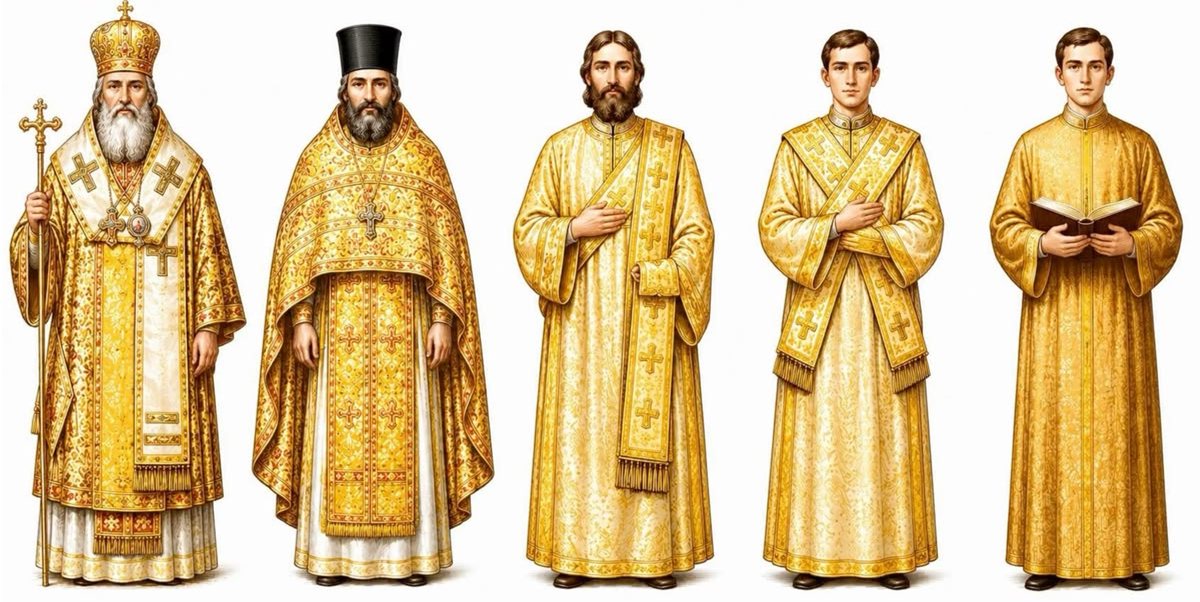
Orthodox vestments are not merely historical garments preserved from Byzantium. They are icons of the Kingdom of God. Each garment teaches a spiritual lesson, and each prayer reminds the wearer that ministry is a gift of divine grace rather than personal merit.
The progression from altar server to priest also reflects increasing responsibility rather than increasing honor. Every rank exists to serve Christ and His Church. The sticharion, worn by nearly every minister, is a powerful reminder that all ministry begins with the garment of salvation received in baptism.
The prayers of vesting emphasize humility, purity, righteousness, strength, and joy. Together they prepare the clergy and servers to stand before the Holy Altar not as private individuals but as servants of the living God.
Ultimately, every vestment points beyond itself to Christ, who clothes His faithful with salvation and calls them to serve His holy Church “in the beauty of holiness” (Psalm 95 [96]:9).